

One of the arguments used by Japan’s fossil fuel lobby to hinder renewable energy is that solar power poses a security risk. That’s because it makes Japan too dependent on China. The Lobby compares it to Europe’s dependence on Russian natural gas. This was never a sound argument since a one-time purchase differs from continual daily dependence, and other sources of solar panels are being cultivated.
Now, however, the war in Iran is making the public aware of that argument’s sophistry. By relying so much on oil, natural gas, and coal, Japan has made itself a hostage to the machinations of Donald Trump, Benjamin Netanyahu, and Ali Khamenei.
Japan relies on the Middle East for around 95% of its oil supplies and 11% of its liquefied natural gas (LNG) imports. Around 70% of oil and 6% of gas have to pass through the Strait of Hormuz. More to the point, a fifth of global supplies of both oil and gas go through those straits, and Japan has to pay the spiking global price. Depending on how long the war lasts and how much damage is done to oil and gas facilities throughout the region, Japan could be severely impacted.
As of today, the price of oil is $88 per barrel, up from $69 in 2025. The price of LNG in Asia is $25, up from $12 last year.
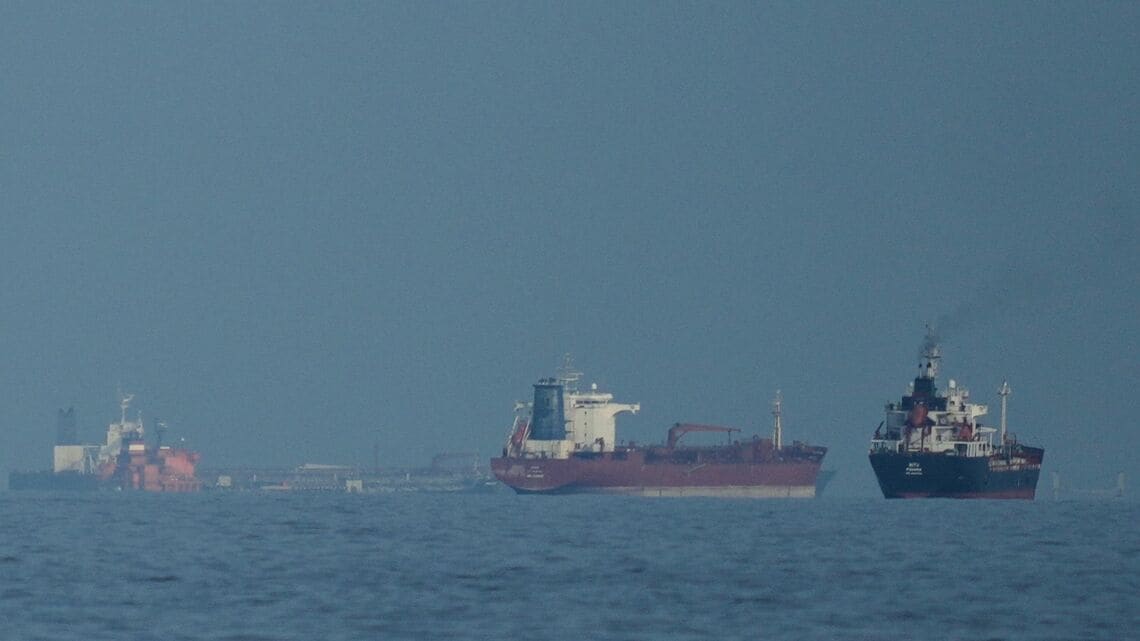
While Iran has restricted exports by others, it is exporting more than ever, mostly to China, and thereby making more money. Tehran lets its tankers traverse the Straits but stops those of other countries. It has attacked ships in the area, including one Japanese-owned ship. An Iranian leader has said that if the war continues, it will try to drive the oil price to $200. Despite Trump’s macho talk, the US has turned down requests to escort ships until it has ended Iran’s capability to attack—a lesson in American unreliability that Tehran wants to drive home.
If the impact on Japan is limited to a big price hike—rather than a cutoff of supply—that would be bad enough. If oil returns to $120/barrel and stays there for a while, it would shave 0.47 percentage point off annual GDP growth and boost the inflation rate by 0.83 percentage point, according to Takahide Kiuchi, executive economist at the Nomura Research Institute. When the war began, he declared, “If prices keep rising, the level of personal consumption cannot be sustained, and the Japanese economy could go into recession.”
Moreover, Nomura says that for every 10% hike in oil prices—if it lasts a year—the yen will weaken by 3 to 4 points. On a gut level, that feels like an excessive forecast to me. In any case, the more the yen falls, the bigger the price hikes in energy and food will be.
A more frightening threat is attacks on oil and gas facilities by both sides. Depending on how much damage is done, it could take months, perhaps years, to restore normal capacity. LNG may be even more vulnerable than oil. Consequently, for the first time since the 1973 temporary oil embargo by Arab countries, Japan could face an inability to secure sufficient supply at any price. Japan has only a couple of weeks’ worth of LNG in its stockpiles, compared with 200 days of oil.
The last time oil prices spiked—in 2022, to $101 for Brent crude and $33 for gas—the cost of energy imports to Japan doubled, from 3% of GDP to 5.8%. Oil accounts for half of this energy bill. The 2022 increase was worsened by the sharp depreciation of the yen from ¥110 in 2021 to ¥131. Last year, when oil cost $69 and the yen averaged ¥145, fuel imports cost Japan 3.3% of GDP.
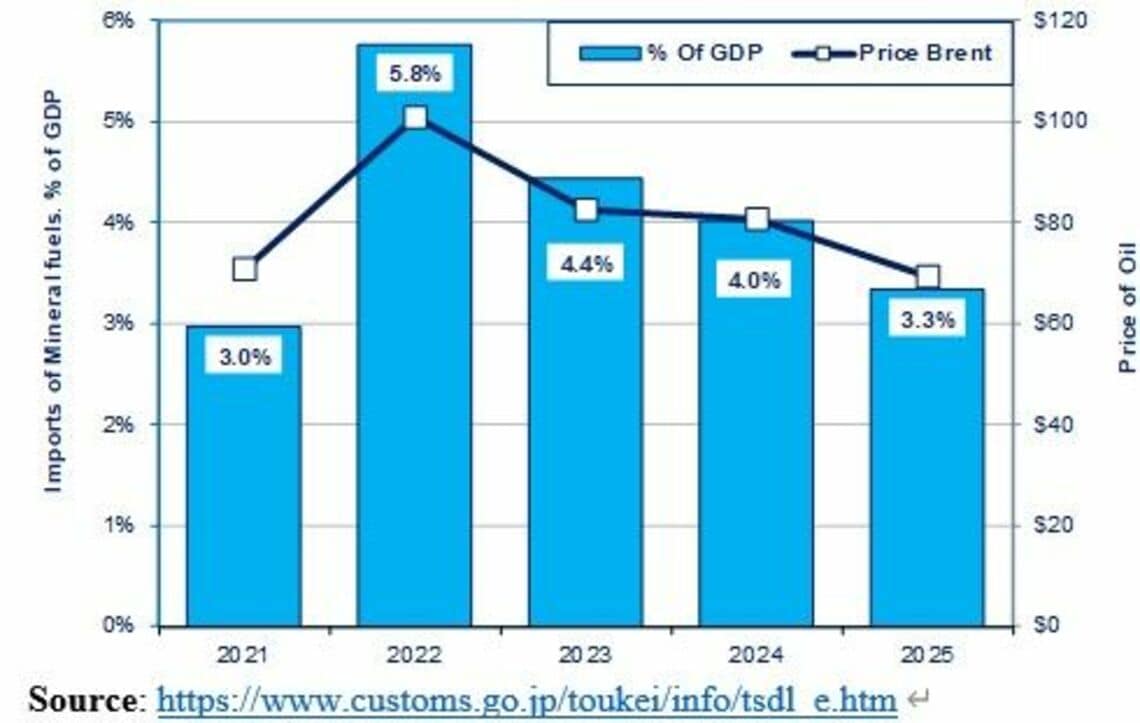
So far this year, the yen has averaged ¥156 and has not yet fallen much. Today, it’s almost ¥159. But, depending on how long the war lasts and the level of physical damage, the yen could weaken much more. Hence, Japan could be forced to spend 6-7% of GDP, or even more, for oil, gas, and coal.The price of Brent crude on March 12 was $100, the same as in 2022, and the continuing Iranian attacks on ships and oil facilities could easily send the price higher if the US does not respond effectively.
A leap in Japan’s import bill would create a huge transfer of income from Japanese households to foreign countries, a hit that would surely depress the economy.
It’s not just oil. When oil prices soar, so do the prices of natural gas and coal. True, Japan has long-term contracts for oil, natural gas, and coal. But they only secure the supply, not the price. It doesn’t even ensure supply if a war or natural disaster prompts suppliers to invoke the “force majeure” clause in their contracts, as some have already done. So have some Asian suppliers of petrochemicals. There is already a race to secure LNG supplies.
On the price front, these contracts only protect Japan from day-to-day volatility. They do not protect it from more sustained price hikes. Japan has to pay the global price. Moreover, long-term gas contracts are typically indexed to oil prices. Coal has its own index. However, if oil and gas prices soar, so do coal prices as people try to switch to it.
Takaichi Trying to Stay Noncommittal
When asked in the Diet about Iran being called upon to support the US in its war, Prime Minister Sanae Takaichi said this war does not constitute the kind of “survival-threatening situation” under Japan’s security legislation that would allow Japan’s Self-Defense Forces to provide support to U.S. military operations in the conflict. So far, said Japan’s Foreign Minister, the US has not asked Japan for any support. However, it is a rapidly changing situation, and who knows what Trump will ask for when Takaichi meets him in Washington a week from now (March 19th). Tokyo does not want Iran to consider it an enemy, but it does not want to rebuff Trump either.
In the name of energy security, Japan has tried to reduce its dependence on oil. Between 2014 and 2024, Japan reduced its daily oil consumption by 26%. For example, it switched from oil to LNG for electricity generation. That was the fourth-largest reduction among 33 mostly rich countries.
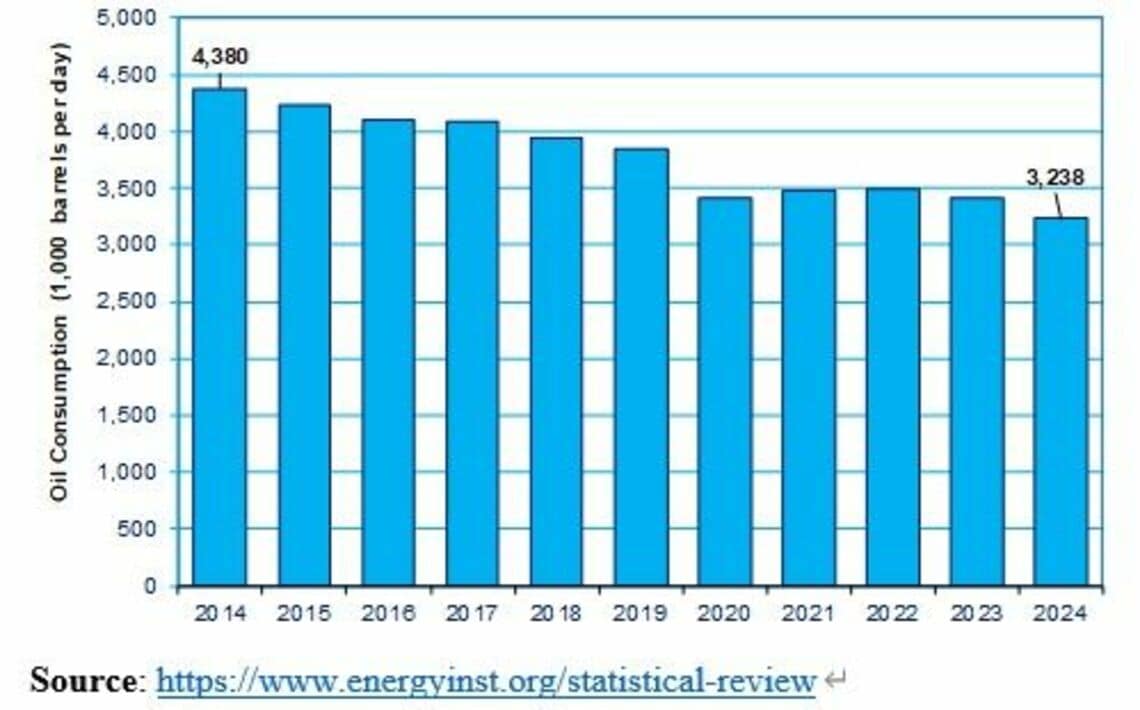
As a result, Japan is right at the median of 33 mostly rich countries in terms of oil intensity,” i.e., barrels of oil per dollar of GDP, using the constant 2015 purchasing power parity value of GDP.
But that did not reduce its dependence on all fossil fuels anywhere near as much. While 83% of Japan’s primary energy now comes from fossil fuels, it’s 80% in China and the US, and 67% in the European Union.
EVs And Renewables Would Reduce Japan’s Vulnerability
Oil supplies half of Japan’s total energy consumption, and half of all oil consumption is used to fuel autos and other transportation. So, Japan could greatly lessen its vulnerability on the oil front by shifting to Electric Vehicles. However, its automakers mightily resist that move.
Compare Japan to China, where battery-powered autos (BEVs) and Plug-in hybrids (PHEVs) now account for half of all current sales, and 12% of all vehicles on the road. Both shares are rapidly rising. China has offered subsidies to those who trade in their gasoline cars for electric vehicles. As a result, a government-linked research has said China will reach peak oil consumption in 2027. Already, in 2025, said this researcher, EVs reduced oil consumption by 582,000 barrels per day, or 3.3% of its current usage. The Rhodium group estimates EVs have cut oil demand by 1 million barrels per day, or almost 7% of oil consumption.
Given that half of China's oil, as in Japan, fuels vehicles, that reduction will grow rapidly as the number of gasoline cars on the road falls. The International Energy Agency believes China has already hit a plateau in oil consumption .
Renewable electricity has enabled China to vastly increase its electric output while reducing fossil use. From 2015 to 2023, fossil fuel use in final energy across buildings, industry, and transport in China fell by 1.7%, even though electricity consumption soared by 65%. With growth in renewables now exceeding overall growth in electricity consumption, it’s only a matter of time before China, like other countries before it, sees a substantial absolute decline in fossil fuel use.
If China Can Protect Itself, So Can Japan
The only obstacles to Japan shifting to renewable energy and making a genuine effort in EVs are the power of the fossil/nuclear lobby and the stubbornness of automakers who want to stick to what they’re used to. The latter problem is called “the innovator’s dilemma.” Regarding renewables, claims about a lack of land or about China have proved fallacious. Berkeley Labs says Japan could have 70% renewable electricity by 2035.
Tokyo is saying it can go slow on renewables and still become more secure by increasing nuclear power. The reality is that nuclear power is not only expensive but also takes a long time to build. Moreover, public distrust remains a big obstacle. Tokyo’s long-term goal is for nuclear power to account for only 20-22% of electricity generation, and experts doubt Japan can even do that.
Precisely because Japan, the US, and Europe have abdicated from solar power production, China has been able to step into the vacuum, including in developing countries around the world. Solar power is cheaper than fossil fuels and nuclear power, but only over the long haul. There are high upfront costs that poorer countries find difficult to manage. China has been instrumental in helping these countries overcome this hurdle, not only through cheap panels but also through financing. This creates obligations and influence. China’s role has enabled 25% of emerging markets to leapfrog the US in end-use electrification. 63% have leapfrogged it on solar generation share. This will be the topic of a future post.