

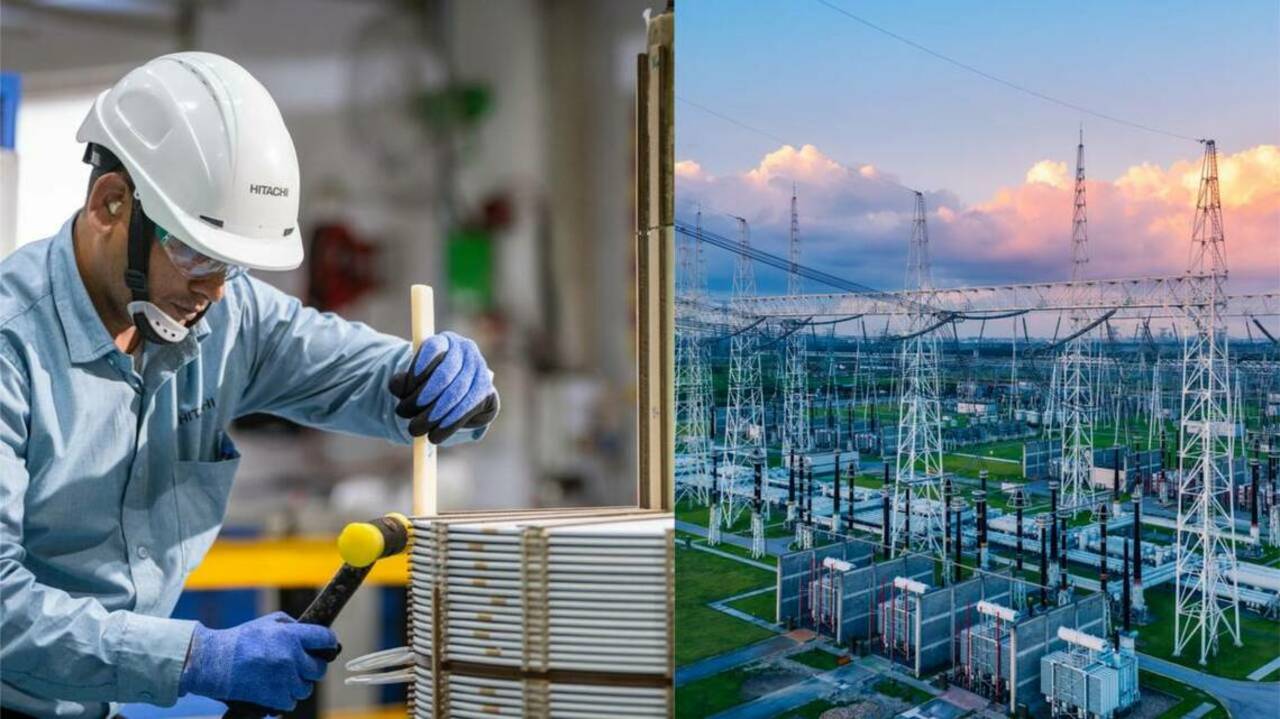
Hitachi Energy, the group subsidiary that handles power transmission and distribution, accounts for approximately 26% of Hitachi's total adjusted operating profit (fiscal year ending March 2025).
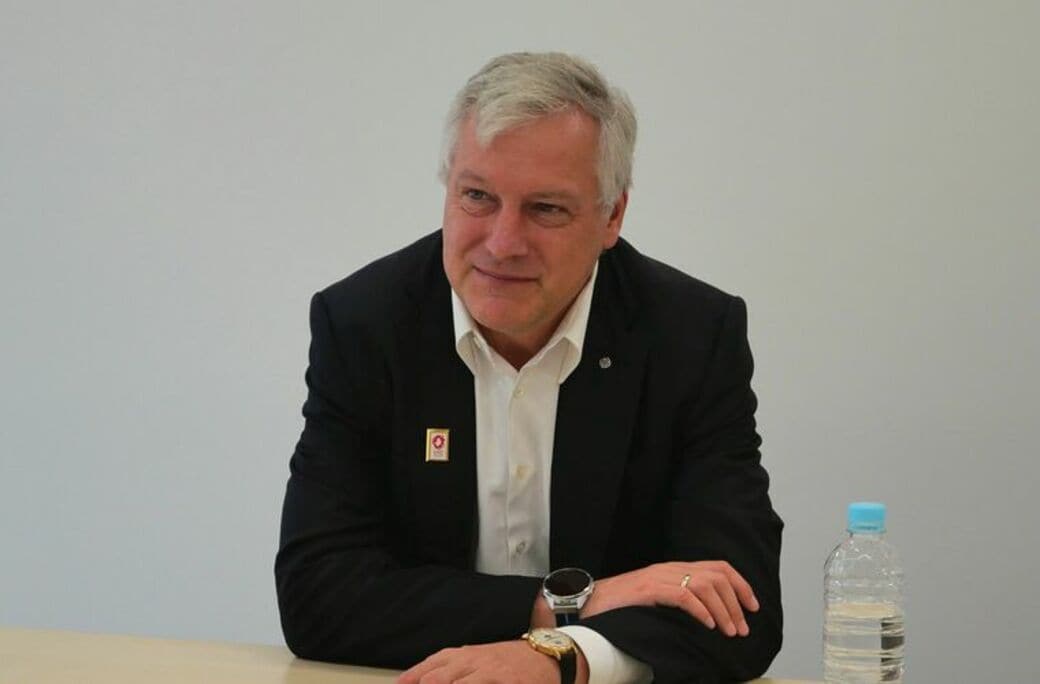
Amid surging global electricity demand, its order backlog has reached $47.6 billion. We spoke with Andreas Schierenbeck, who has served as CEO of Hitachi Energy since July 2024, about the realities of a business riding the AI boom and beyond.
Supply and Demand Are Completely Out of Balance
How do you view the current energy market?
The energy market is strong — and "strong" is an understatement. Until three, four, five years ago, the market was essentially flat. The industry had excess capacity; we were closing factories and taking capacity out. It was not a strong boom.
Now, the market has tripled against initial projections. You can see it in all kinds of indicators — and you can see it in the supply-demand gap and how we as an industry are struggling with our customers to fill it. Supply and demand are definitely not in balance.
We currently have an order backlog of beyond $50 billion, with visibility of more than six years. That is definitely not a normal situation — one we haven't seen for decades. We are using the full capacity of our factories to deliver.
We are also undertaking one of the biggest investment programs I have ever seen in this industry. We have already spent $3 billion over the past three years and are planning to spend $6 billion more in capacity expansion going forward — $9 billion in total. We are investing $1.5 billion in transformer factories alone.
Normally, customers plan on the basis of long-term demand of 10, 15, or 20 years. Their capex budgets are now tripling and quadrupling. I don't see this market returning to where it was in the next 10, 15 years — or even longer.
What is driving this market expansion?
Going back two or three years, nobody — investors, reporters, industry insiders, customers, nobody — saw this boom coming. Everybody was surprised.
Today, people understand that electricity and energy are critical to security, safety, and resilience. A lot of people switched from molecules to electrons because electricity gives you more options — you can buy it much more flexibly than gas or coal. Electromobility added to that. A lot of industrial processes are being electrified to move away from molecules. All of that added to demand.
Then data centers entered the picture. Data centers used to mean 10, 20, 30 megawatts — not a big problem for the grid. Nobody expected these customers to show up needing 500 megawatts or one gigawatt. And the companies building AI data centers have virtually no financial constraints. They can build as fast and as much as they want.
The supply side has changed as well. In the past, you built a power plant close to where the demand was — next to a big chemical plant, a big industrial complex — so there was no need for a long grid.
Renewables are different. Onshore wind, offshore wind, solar — they are almost always far from demand centers. You need a strong grid to cover those distances. We have been building renewables like crazy, but we have not invested in the grid. Suddenly, the grid became the missing link between generation and demand.
All of these factors have converged. And I think this trend will continue for some time.
Transformer Factories Running at Full Capacity
There are growing concerns about a shortage of transformers. How do you see that?
From a market perspective, the answer is yes — but from where I sit, as a producer, it's no. Our factories are full, and we have secured capacity through operational frameworks and capacity reservation agreements. So for us, the situation is very foreseeable.
We are investing only in bankable business cases. The capacity we are currently expanding is already contracted and, in many cases, prepaid — so it is not changing the supply situation on the market.
For customers without a capacity reservation, the wait can be two, three, or four years, depending on the timing. That is what people are calling a shortage.
When I was running a major German utility, I could submit a spec and have a transformer delivered eight months later. Those days are over. Customers who have not adapted to this new reality are going to struggle.
Do you think data centers need to be regulated?
Of course, regulations need to change. They were designed after market liberalization to protect taxpayers and consumers — to keep costs under control, to be conservative. This is not working anymore.
Data centers have started to grow so fast that they are creating a bigger issue than anybody anticipated. You have to connect big loads to the grid, and the cost of that network connection is paid by everyone — ordinary consumers. Yet there is a discussion about whether this is fair, given that data centers are not creating that many jobs or contributing that much to GDP.
Current regulations are built on the principle of non-discrimination: if someone requests a grid connection, you have to provide it. And in most countries, everyone pays equally. But you are already seeing movement in the U.S., where some utilities and their customers are going to regulators asking for permission to charge data centers higher tariffs — to bring down costs for everyone else in the community.
Then there is the restart of Three Mile Island — Microsoft was prepared to pay much more for that energy than anybody else, because restarting a nuclear unit that was shut down for not being competitive is not going to be cheap. And more and more data centers are thinking about building their own energy supply entirely, without a grid connection, because they cannot get what they need fast enough. That is another complication.
Building New Factories — But Not in a Rush
Hitachi Energy plans to invest $6 billion by 2027. How is that being allocated?
The first step is expanding existing factories — in the U.S., India, Germany, Sweden, wherever we have them — to their maximum capacity. That is the lowest-risk approach.
New greenfield construction is proceeding slowly and deliberately. We have launched one greenfield project in India because there is good underlying growth there — but that is the first one we have done. Total investment in transformer factories worldwide stands at $1.5 billion.
The remainder goes into services, M&A, R&D, and supply chain. We believe in a global supply chain combined with local value creation — not concentrating investment in one place.
Your service business currently covers less than 1% of an installed base of roughly 500,000 units. The medium-term target is to grow that fivefold, including through M&A.
We launched the service business unit in April. One purpose is to hedge against a future downturn — if new projects and contracts eventually decline, a strong service business provides a floor. It also keeps customer relationships healthy.
Growing four to five times means roughly 50% per year. But the potential in the existing installed base is significant. Our customers are running out of people — they are focusing their resources on new projects, which is where the money is. They do not have the personnel left for service. That is the niche we are going after.
Since Tokunaga-san became president in April 2025, have you noticed any changes?
What I appreciate about Tokunaga-san's leadership is his deep expertise in digital, which is essential for our business. Moving into services, expanding HMAX, all of that needs digital capabilities, and he is supporting that in a very strong manner. That is very good for us.
The digital world and the electricity world are now intertwined. Running volatile assets like solar and wind, dealing with volatile demand, building networks that are more tightly connected — including internationally through HVDC — requires much more software and AI than before. Hitachi's push on AI and Lumada comes at exactly the right time for the energy sector.
More Than a Transformer Maker
Hitachi is pursuing a "One Hitachi" vision through Lumada. What does that mean for the energy business?
I would call it an opportunity rather than a challenge. What Hitachi means to me is an organization where ideas, business models, and expertise are exchanged inside the group for the best of Hitachi — and there are a lot of opportunities in that.
Take vegetation management. It may sound like an odd example for the energy business, but for our customers, it is one of the biggest things they have to deal with.
They have to cut the vegetation — the bushes and trees — below overhead lines. There are a lot of regulations, hundreds of miles of lines to cover, and only limited resources. If vegetation grows too much, you get fires and outages.
Normally, that is not something we would handle. But together with Hitachi's Digital Systems & Services (DSS) division and Amazon, we found a way to use satellite imagery and generative AI to identify where vegetation is changing and to focus crews on the hotspots.
We alone would not have seen that solution — we do not work with satellite data in that way. And our DSS colleagues would not have seen it either, because they would not have understood the customer's business case. It only works because the two sides came together. There are many examples like this, and we expect similar results in rail as well.
How will Hitachi Energy contribute to Lumada revenue growth?
Primarily through the growth of our service business. That is Lumada — software, recurring revenue, and ongoing customer relationships. We will deliver significant growth to that target by fiscal 2027, and the direction is very much aligned.
This article is part of "Hitachi's Global Ambitions," a special feature originally published in Toyo Keizai from July to November 2025. English edition prepared for The Oriental Economist.