


It was early in Donald Trump’s first term when I asked a Foreign Ministry what Donald Trump’s election meant for Japan. By then, Trump had already pulled out of the Trans Pacific Partnership (TPP), began to levy tariffs on steel and aluminum on alleged “national security” grounds, and threatened to weaken the US-Japan Security Treaty and NATO unless Japan and Europe greatly upped their defense spending. I’ll never forget the official’s reply: “Our problem is not Trump; it’s that the American people voted for him.” He feared that Trumpism could last even if the Democrats returned to the White House. He was partially right in that Joe Biden mostly kept Trump’s tariffs in place and tried to block Nippon Steel’s acquisition of US Steel. Only on security issues did Biden return to traditional bipartisan stances.
But now Trump and his extremist MAGA (Make America Great Again) faction of the Republican Party have been decisively repudiated in the November elections. Not only did Democrats and independents come out in record numbers, but many traditional Republicans were so disenchanted with Trump that many of them stayed home, and a small share even voted for Democrats. As a result, Democrats now have a 56-to-44 majority in the Senate and are expected to have a dominant 260-to-175 majority in the House of Representatives. Democrats won seats in states and districts that Trump had won handily in 2024. While forecasters expected the Democrats to retake both houses of Congress, none predicted such an overwhelming triumph.
Moreover, voters rejected Trump policies on a variety of fronts that impact Japan. 62% of all voters wanted an end to the Trump tariffs, including 93% of all Democrats (see chart below).
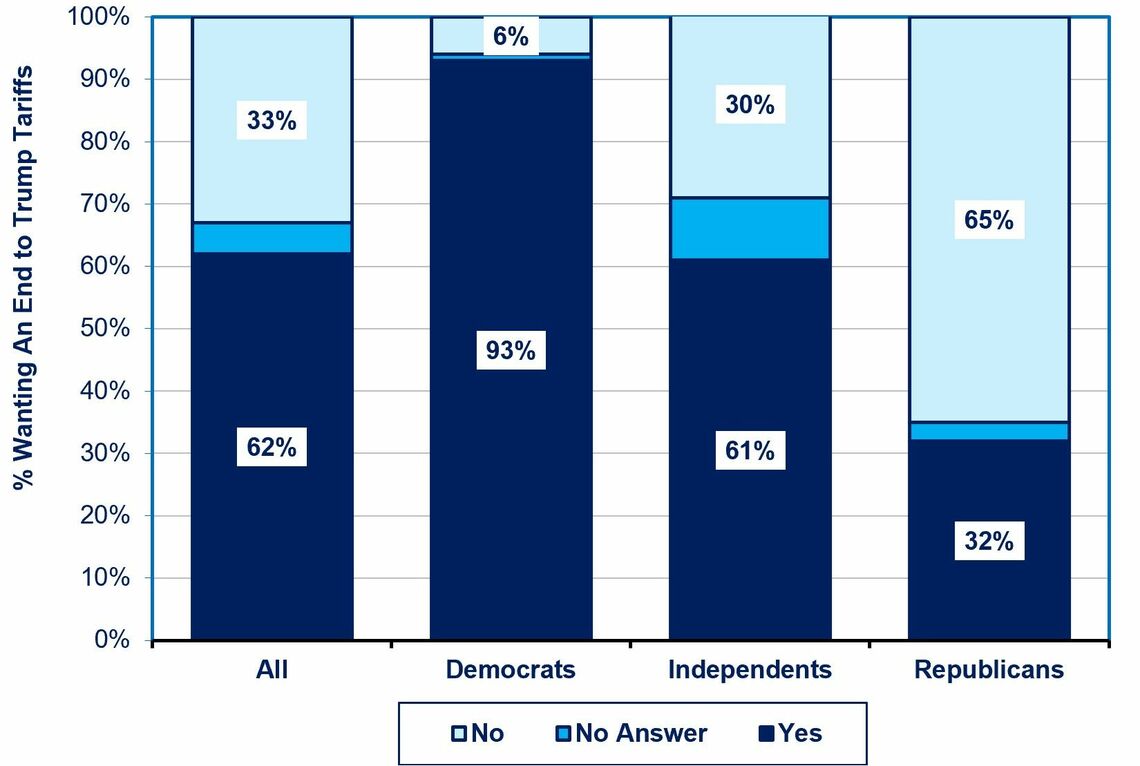
The Democrats have declared that ending the Trump tariffs will be one of their highest priorities when they take over Congress in January. However, rather than seeking compromises that would appeal to Republican voters, Trump and his allies in Congress reacted to their defeat by becoming even more devoted to tariffs and considering imposing even more.
71% of all voters wanted an end to the Iran war, including almost all Democrats and half of Republicans. Trump is ignoring the voters on this. Even if Congress passes a resolution demanding an end to the war, Trump can veto it, and Democrats lack the two-thirds majority to override that veto. Even if Congress votes to cut war funding, Trump can find other allocations to the Pentagon to fund it.
Voters also opposed building AI data centers in their communities, including 87% of Democrats and 62% of Republicans. This affects Japan greatly because much of its exports consist of inputs for US data centers. Some inputs are shipped directly to the US and others, e.g., chipmaking equipment, are exported to third countries, which then export the final products to the US. AI-related products largely drove the 17% rise in exports in September the year earlier.
Can Democrats Repeal Trump Tariffs or Just Create An Issue For 2028?
Democrats most likely will not succeed in repealing Trump tariffs in the two years before the next election, except perhaps in a few cases. More likely, they will only create a big issue for the 2028 election. Trump doesn’t seem to care that he lost so much support among Republicans and independents over this issue. Congressional Republicans will be under immense pressure not to defy Trump, lest he support a Trump loyalist to defeat them in the 2028 primaries, as he did in 2026.
This could create an insurmountable obstacle for the Democrats. In the Senate, they can bring an issue to a vote only if 60 Senators vote to do so. So, the Democrats would need to corral four Republicans. Trump would likely veto any such bill. And it would take two-thirds of each house to override him.
The first test of Democratic intentions and capabilities will be an attempt to legislate repeal of the tariffs vis-à-vis Canada. Not only are Democrats united on this issue, but many Republicans in Midwest states also favor repeal. That’s because so many industries in their states are hurt by the tariffs. According to press reports, the Democratic strategists believe this is their best chance of getting something passed in Congress. Even if they cannot override a Trump veto, they believe this will show voters that the Democrats are doing as much as they can.
The Democrats have another reason for starting with Canada. It may be the one part of the tariff issue on which Democrats are most united. Democrats are very divided on trade. A mainstream liberal “caucus” in the House called the New Democrat Coalition—which grew from 114 seats to 142 members after the midterms—has consistently supported free trade agreements. It has made this support conditional on including provisions that favor the middle class and some industries, while pushing back against what it believed were excessive demands by some corporations. Its views are similar to those of Presidents Clinton and Obama. Thirty of the NDC’s new members are Democrats who were able to flip Republican seats. This reinforces their view that their policies are the best path to maintaining their new majorities.
The left-of-center Congressional Progressive Caucus—which grew from 100 to 105 members after the election—has consistently opposed almost all free trade agreements, including NAFTA, the TPP, and the US-Korea FTA. So they may want to attach conditions to any repeal that others find unacceptable.
Whatever the Democrats present vis-à-vis Canada will show how much these divisions can be overcome. Once the agenda expands beyond Canada, unity may prove more difficult, as attitudes differ across countries and industries.
Only a minority of voters want to repeal all tariffs vis-à-vis all countries. Contrary to popular belief among Japanese leaders that the Republicans are Japan’s friends on trade, a recent poll reported that 35% of Democratic voters wanted to repeal all tariffs on Japan and just 15% of Republicans.
Can the Democrats Win In 2028 and Then Repeal the Tariffs?
For tariff repeal to succeed, Democrats would have to capture the White House in 2028 and keep their majority in both houses of Congress.
The most basic reason for the Democratic landslide this year is a big surge in turnout among pro-Democratic voters and a big drop in turnout among traditional Republicans who voted for Trump in 2024 but now feel betrayed by the tariffs and the Iran war.
However, a major long-term factor helping Democrats is a pivotal demographic shift in formerly Republican states. Texas epitomizes this change. Democrats won not only the Senate seat but also the Governorship, both for the first time in over 30 years (the Senate seat since 1988 and the Governorship since 1990).
To see why, consider Collin County, a suburb of Dallas. Between 2000 and 2026, the population grew from 500,000 to 1.3 million. As the population grew, the Democratic share of the total vote rose from 24% in 2000 to 55% this year (see chart below).
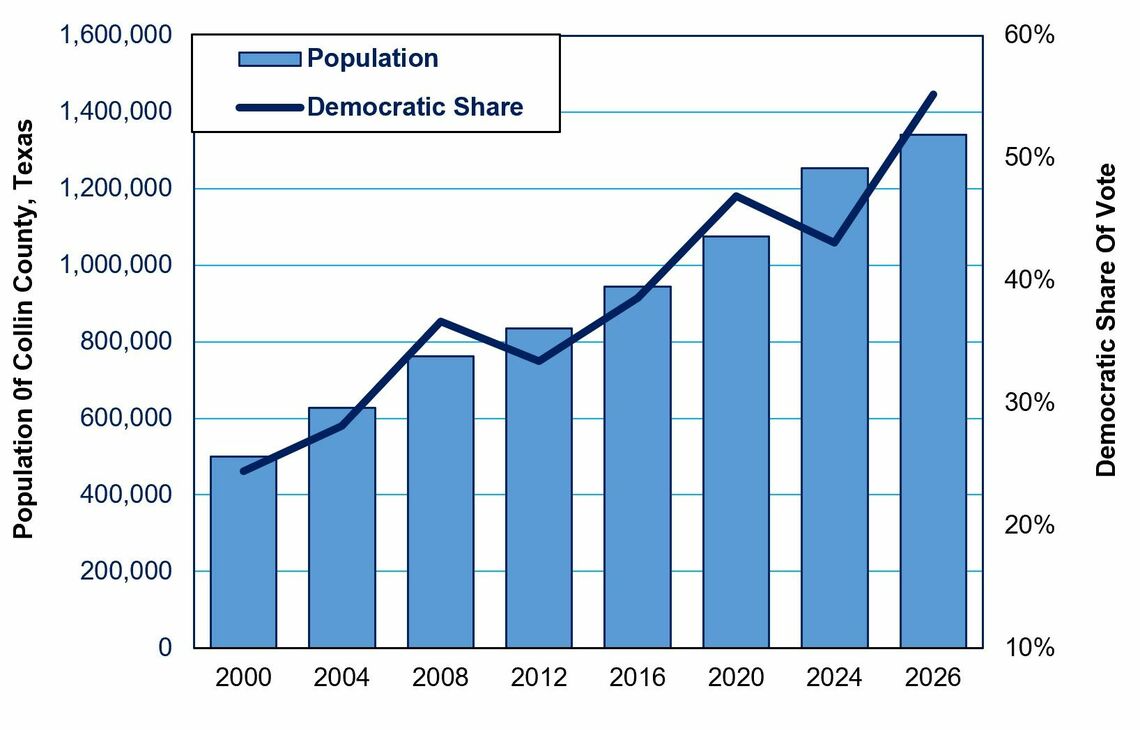
The population grew because many people moved to Collin from foreign countries and other US states. Those who came to Collin from other states rose from 37% to almost 60%. And those who came from foreign countries rose from 13% to 23%. I learned about the reasons why when I spoke at a Japan Society meeting there a few years ago. Many leading companies, including Japanese ones, moved facilities from other states, e.g., California, because taxes, wages, and the crime rate are relatively low. As these companies moved in, many of their employees moved with them. Other people also moved to Collin to join them. And they brought with them their prior preference for moderate Democratic policies. Japanese companies played a significant role in this shift. The Dallas region hosts 265 leading Japanese companies, and Texas hosts 400. Statewide, Japanese companies employ 80,000 people directly, not counting those employed by their suppliers.
Similar trends appear in other southern states. While Japanese companies are a small fraction of the overall trend I’m describing, they typify the demographic change fueling the political shift.