


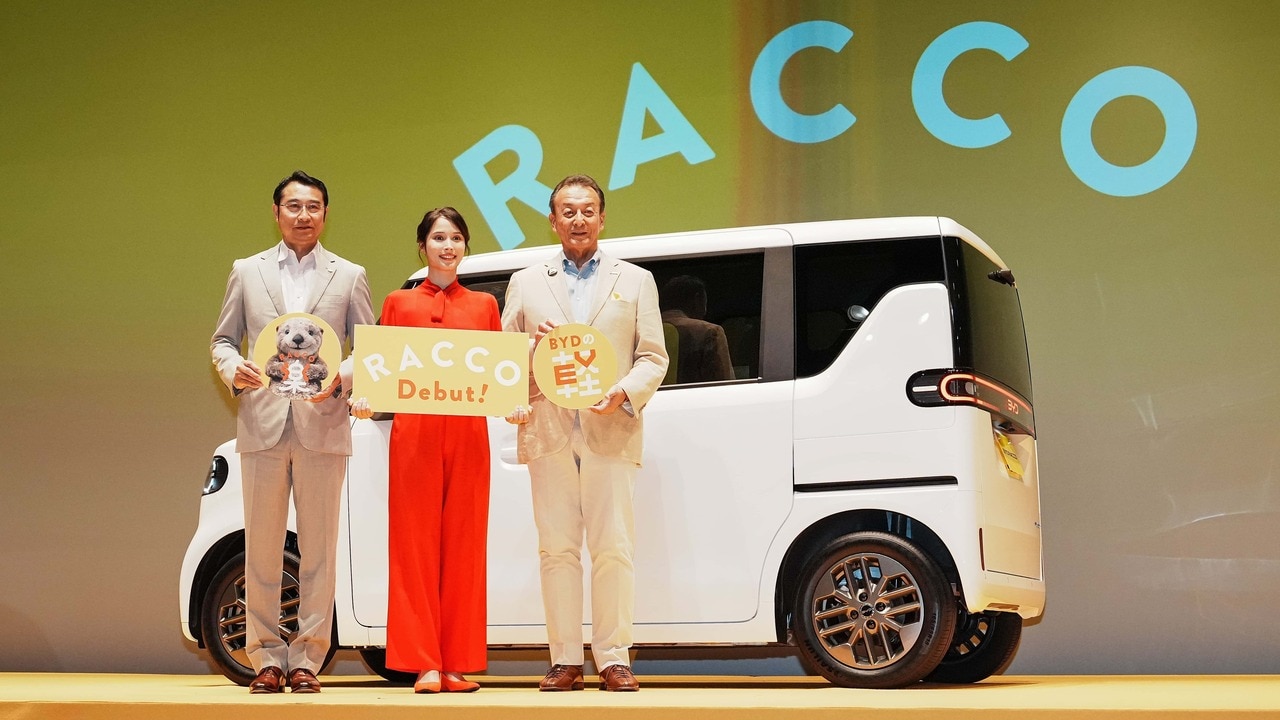
“We want to use our technology to bring unprecedented convenience and fun to Japanese people,” Liu Xueliang, Chairman of BYD Auto Japan, remarked.
On July 28, BYD launched its electric “kei car” (mini vehicle) (hereafter, “kei EV”), the “BYD RACCO,” in Japan. This marks the first time an overseas manufacturer has released a kei EV in Japan, and entry into the so-called “kei car” market—traditionally the exclusive domain of domestic automakers—is almost unprecedented for a foreign brand.
In 2025, BYD overtook Tesla to become the world's largest electric vehicle manufacturer. Looking at the automotive industry as a whole, it ranks sixth globally in vehicle sales, surpassing Ford and Honda. However, despite entering the Japanese market in 2023, its sales total in 2025 remained at just 3,742 units, accounting for less than 0.1% of Japan's domestic new car market of around 4.5 million units. Consequently, its entry into the kei car segment is drawing intense attention.
The kei-car market has long been a stronghold for Japanese manufacturers. Aside from a few exceptions, foreign automakers have virtually stayed clear of this segment. Why, then, is BYD challenging this stronghold?
Enthusiasm to Become "Part of Japanese Society"
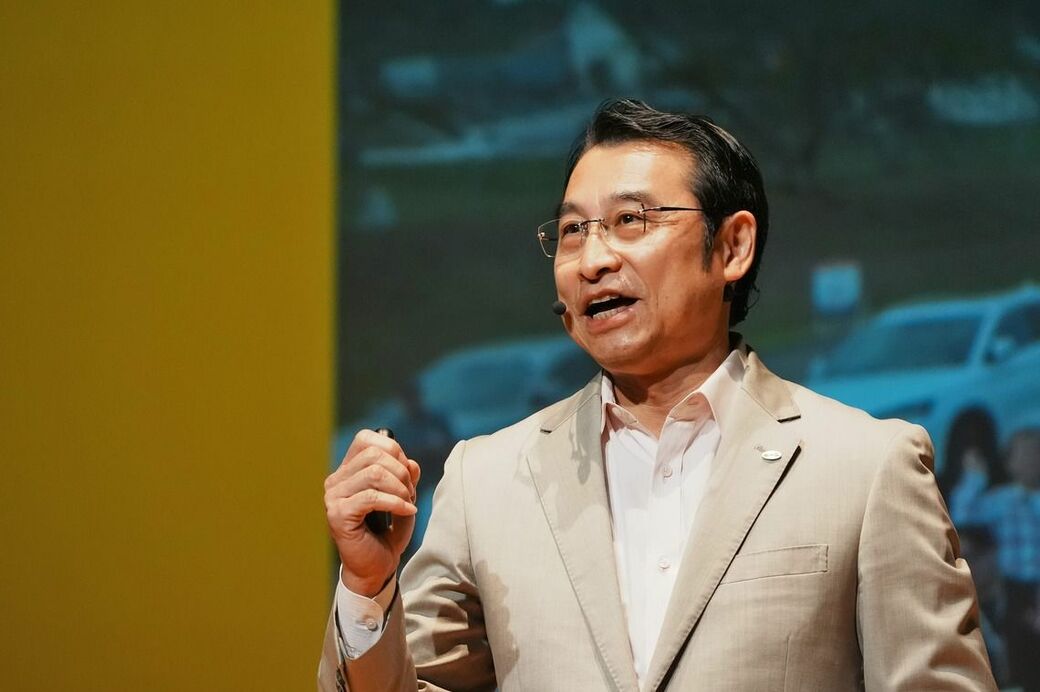
“Kei cars are part and parcel of Japanese society. You can't talk about Japanese society without them,” says Chairman Liu.
Kei cars are a unique automobile category in Japan and account for approximately 34.5% of new passenger car sales (FY2025, compiled by Japan Automobile Dealers Association and the Japan Light Motor Vehicle and Motorcycle Association), demonstrating that kei cars serve as a backbone of Japanese society. Flagship models include Honda's N-BOX, Suzuki's Spacia, and Daihatsu's Tanto.
On the other hand, the overall adoption rate of EV passenger cars in Japan (excluding kei cars) remains low at 1.6% (2025, Japan Automobile Dealers Association), and the kei EV lineup is limited to options such as Nissan's Sakura and Honda's N-ONE e:.
At the launch event, Chairman Liu recalled visiting Japan more than 30 years ago and being astonished by the vast number of kei cars. One of BYD's main objectives in releasing the kei EV RACCO is to increase its brand penetration in the Japanese market.
Major Chinese automaker Chery Automobile has also established EMT, a joint venture with Japan’s automotive retailer Autobacs Seven and others, planning to introduce its first kei EV model by 2027. Domestic Japanese players are also moving: Suzuki plans to launch its kei EV model "e-SKY" in FY 2026, and Honda plans to introduce the "N-BOX EV" in 2028.
The RACCO comes in three grades: 200, 300 Plus, and 300 Premium. The most anticipated detail, pricing, is set at 2.145 million yen, 2.398 million yen, and 2.497 million yen, respectively. Factoring in Japan's national CEV subsidy of 150,000 yen for the RACCO, the effective price for the standard "200" trim starts at 1.995 million yen. Despite facing disadvantageous subsidy terms compared to Japanese manufacturers, BYD targeted highly competitive pricing. The top-tier 300 Premium's effective price of 2.347 million yen sits below the highest grades of both the Nissan Sakura and Honda N-ONE e:.
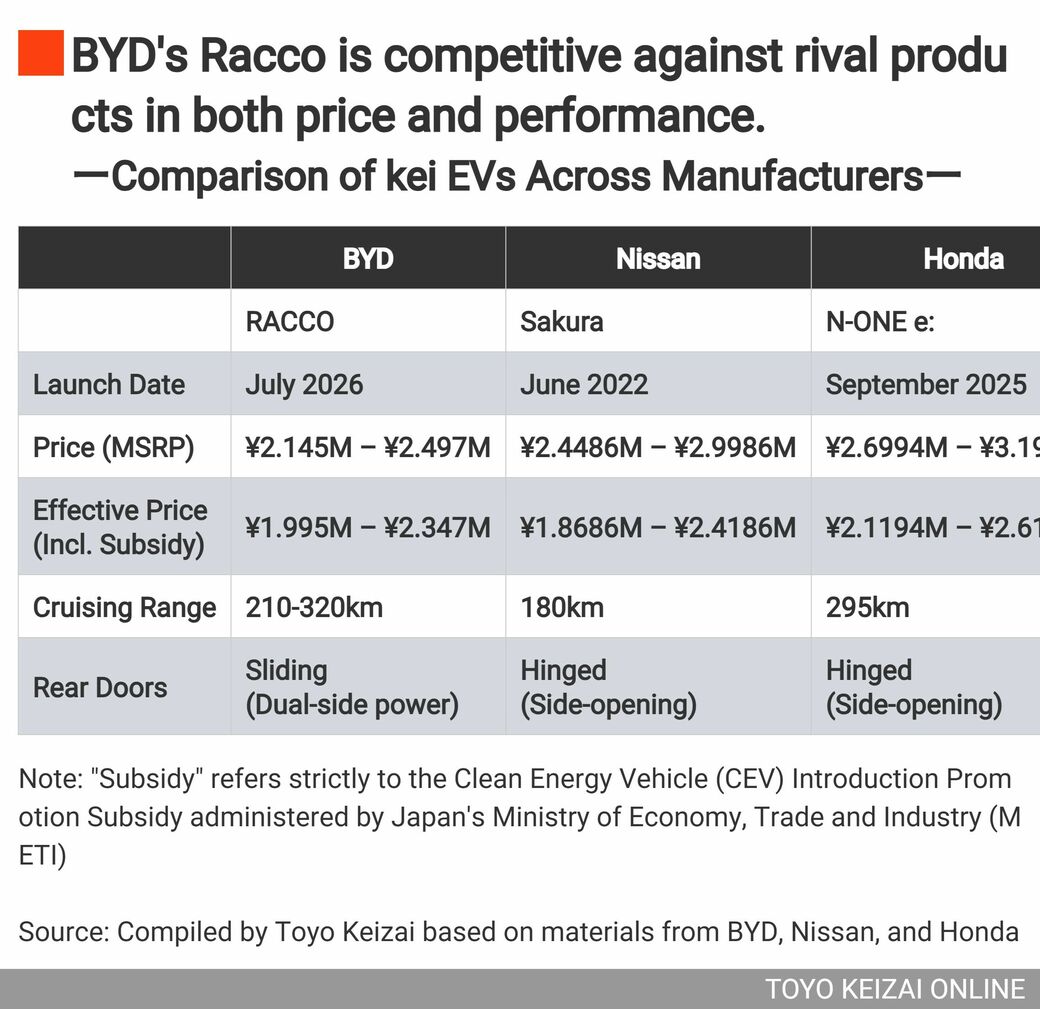
The vehicle also features impressive performance and equipment. The cruising range is 210 km for the 200 trim and 320 km for the 300 Plus and Premium trims—outperforming the Nissan Sakura with its standard trim and the Honda N-ONE e: with its higher trims. Additionally, its overall height of 1,800 mm fits the high-roof kei car category, matching that of the Honda N-Box"; it features dual power sliding rear doors. Both features are firsts for a domestic kei EV.
Advanced Driver Assistance Systems (ADAS) come standard across all grades, alongside support for Over-the-Air (OTA) wireless software updates. Atsuki Tofukuji, President of BYD Auto Japan Inc., emphasized, "It is the world's first Software-Defined Vehicle (SDV) in the kei car class."
New Technology Developed by a Chinese Engineering Team
The RACCO also adopts new technology. BYD developed 'X-Pack,' a new architecture that integrates components such as power distribution and electrical control directly into the underfloor battery. Yang Buyi, Chief Development Officer at BYD Headquarters, explained that this creates an impact-absorbing crash zone at the front of the vehicle, enhancing safety performance even within the kei-car's compact body measuring just 3,395 mm in length.
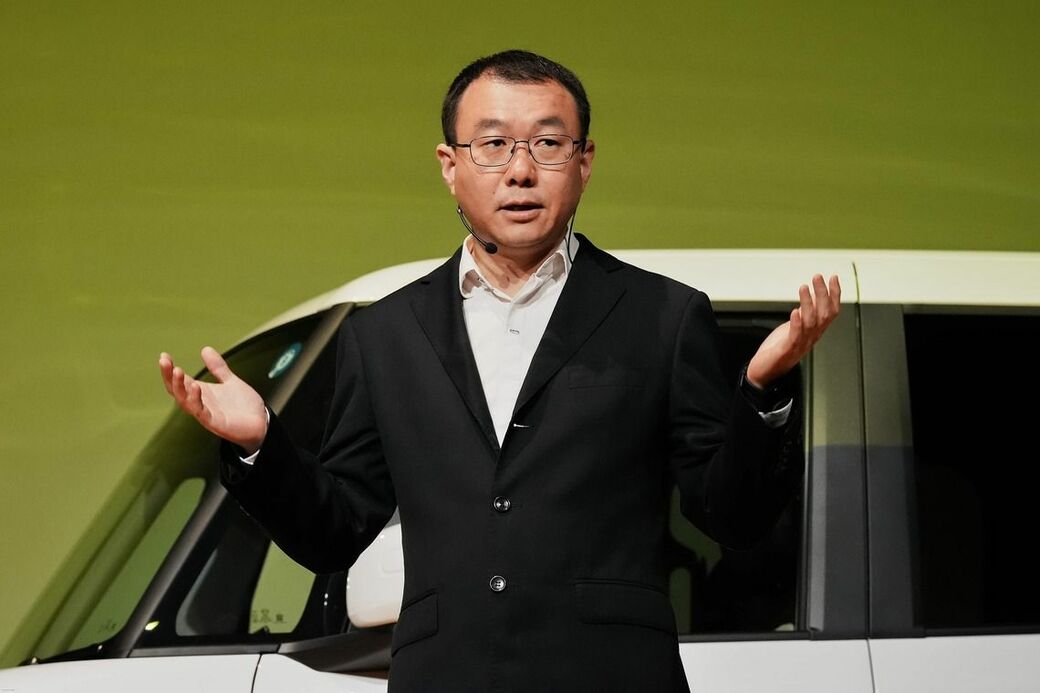
While the decision to develop the RACCO was made two years ago, development of the foundational X-Pack traces back five years. Yang notes, "It represents the culmination of BYD's technological achievements to date."
Development was led by a team of Chinese engineers, incorporating local research and feedback from Japan's marketing team. Hirohide Tagawa—a former Nissan veteran who joined BYD in 2025 as General Manager of Product Planning—recalled that while the design was already largely finalized when he joined, he proposed some adjustments such as making both sliding doors power-operated.
At the event, President Tofukuji set a sales goal of "10,000 units"—roughly 1% of total mini kei car sales in Japan. However, significant hurdles remain.
Lack of a Sales Network and Consumer Hesitation
First is the limited sales network. While major kei car makers Suzuki and Daihatsu each possess around 1,000 sales locations, BYD's official stores stand at just 56 nationwide as of early August this year. Furthermore, while regional areas account for roughly 76% (FY2025) of kei car sales, approximately 40% of BYD’s stores are concentrated in the Tokyo metropolitan area.
President Tofukuji expressed plans to expand the sales network into regional areas, including satellite locations, aiming for 100 stores by the end of the year. Wind is also at their back as Yanase, a major imported car distributor, established a new entity called "Yanase EV Square" to sell BYD vehicles, opening its first store, "Yanase EV Square Isogo (BYD AUTO Yokohama Minami)," in July this year.
In addition to network constraints, Tang Jin, Senior Chief Researcher at Mizuho Bank, points out that BYD faces "three walls": "First is the slow adoption of EVs in Japan, second is the limited kei EV lineup and the resulting consumer hesitation, and third is consumer resistance toward Chinese vehicles themselves." According to AlixPartners' "2026 Global Automotive Consumer Sentiment Survey," 66% of Japanese consumers express aversion toward Chinese-made vehicles. Indeed, a staff member at a BYD dealership in Tokyo noted, "We still hear concerns from customers regarding the quality of Chinese-made products."
Why, then, is BYD entering Japan's mini car market? Takaki Nakanishi, lead analyst at Nakanishi Automotive Industry Research, analyzes that the goal is "penetration and brand establishment in the Japanese market." He states, "Looking solely at sales volume misses the point; the real focus should be on consumer reputation for the RACCO itself and the expansion of brand recognition."
The development of the RACCO could also lead to deployments in other markets for BYD. Although kei cars are unique to Japan, Yang says "there is potential to apply X-Pack technology to other compact models, including those deployed in markets outside Japan."
Whether BYD's RACCO will elevate the company's presence in Japan—and contribute to its broader long-term global expansion—remains to be seen. The market reputation and sales of its kei EV are likely to serve as that touchstone.