

The tropical island of Oahu, Hawaii, and Hitachi share an unexpected connection. The famous “Hitachi Tree,” featured in Hitachi's corporate commercial “What Kind of Tree Is This Tree?”, stands in Honolulu.
Located at the center of Moanalua Gardens, about a 30-minute drive from Waikiki, the tree—known locally as the “Hitachi Tree”—has become a familiar symbol of the company’s presence in Hawaii.
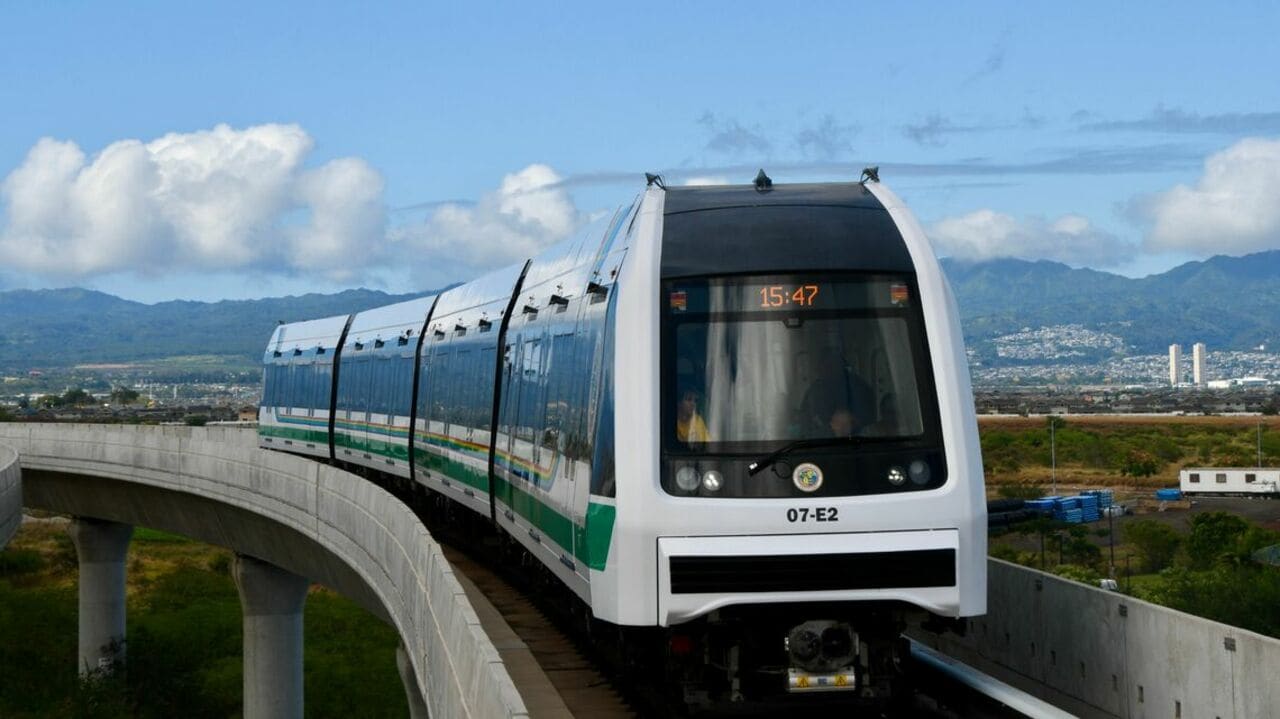
Now, Hitachi has added another, far more complex landmark to the islands: Skyline, an elevated urban rail system linking Honolulu’s suburbs with its urban core. Phase 1, connecting East Kapolei and Aloha Stadium, opened on June 3, 2023. Phase 2, extending the line to the Mid Street Transit Center, began service on October 16, 2025.
Given that Hawaii had no passenger rail service for more than 70 years after World War II, the new rail opening has become a major local topic.
The system is operated by the Honolulu Authority for Rapid Transportation (HART). Hitachi supplied the rolling stock and is also responsible for operations management and maintenance.
While Hitachi typically operates out of the spotlight as a manufacturer, Honolulu Mayor Rick Blangardi praised Hitachi at the Phase 2 opening ceremony, stating, “The remarkable 99.84% on-time performance achieved on the Phase 1 section is thanks to Hitachi's staff.”
A Driverless System on Steel Wheels
Hitachi was not involved in the Skyline project from the outset.
Originally, AnsaldoBreda, a major Italian rolling stock manufacturer, won the contract to manufacture and supply the trains in 2011. Ansaldo STS, another Italian rail company, was awarded the contract for operations management and maintenance.
The project became part of Hitachi’s portfolio in 2015, when Hitachi acquired both companies.
A total of 20 trainsets were built, each consisting of four cars. Like Tokyo’s Yurikamome line, which serves the city’s waterfront, the trains operate automatically and do not require a driver during normal service.
There is, however, a crucial difference. Unlike Yurikamome, which runs on concrete guideways using rubber tires, Skyline operates on steel rails with steel wheels, in the same way as conventional railways. Skyline is the first unmanned rail system in the United States to use steel wheels.
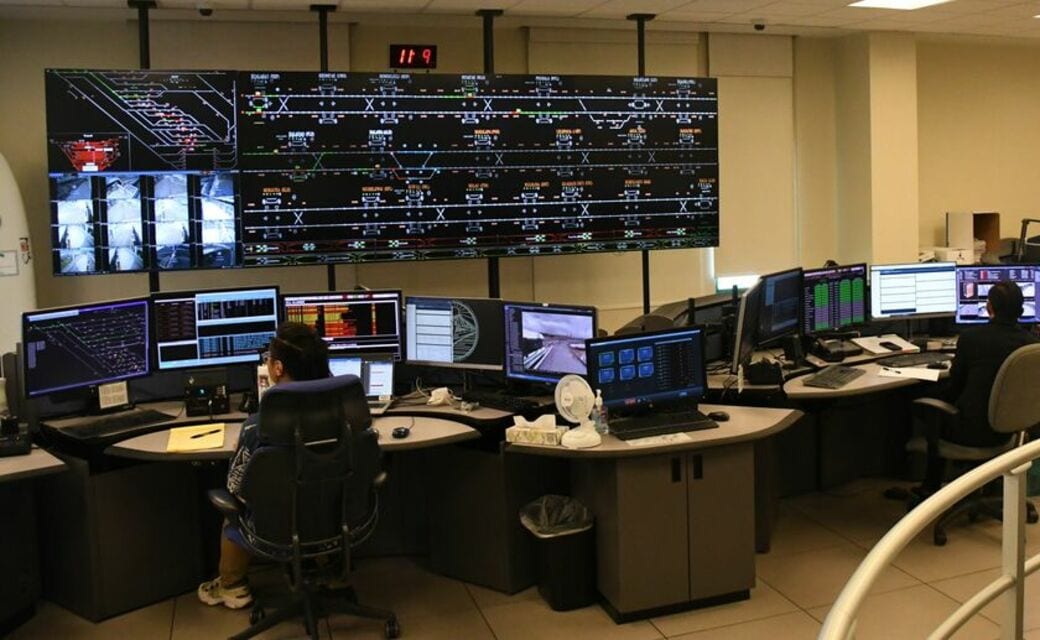
The trains are centrally managed from an operations control center. Inside the command room near Leeward Community College Station, a large panel displays real-time train locations alongside rows of monitoring screens. The center continuously monitors train status and manages unmanned stations using live footage from surveillance cameras installed at the stations.
At the opening of Phase 1, passenger numbers were sparse, partly due to the lack of major facilities along the route. However, according to Mayor Blangiardi, this was “within expectations.”
Phase 2, featuring stations at Daniel K. Inoue International Airport (formerly Honolulu International Airport) and Pearl Harbor-Hickam Joint Base, will significantly enhance the line's convenience for commuters, marking the true beginning of its potential.
Furthermore, the third phase section (Mid Street Transit Center to Civic Center), scheduled for completion in 2031, will pass through office districts and government areas, generating even greater commuter demand. There are also plans to extend the line to Ala Moana Center. If realized, this would greatly improve access between the airport and the Waikiki area.
A long road to rail in Honolulu
Before World War II, freight trains on Oahu transported sugarcane and other goods and were sometimes used for passenger service. Trams also operated in downtown Honolulu. However, both were discontinued shortly after the war.
Today, only a small section of the freight line remains, operating a limited tourist train service. The primary mode of transportation in Hawaii is the automobile, and Honolulu's morning and evening rush hour traffic congestion ranks among the worst in the United States. To alleviate congestion, the City of Honolulu and the State of Hawaii established a rail system in 2005.
The road from the decision to build the railway to its opening was long. Phase 1 was originally scheduled to open in 2017, with Phase 2 planned for 2021. However, environmental assessments along the route and political changes delayed construction, resulting in higher overall costs.
Total project costs, initially estimated at $3 billion to $4 billion, continued to rise and eventually exceeded $10 billion. Local residents have mocked the project as “the world’s most expensive rail line per resident along the route.”
The delayed opening also proved costly for Hitachi. As the line was expected to open in 2017, an operations control center had already been built and staff assembled. The first train set arrived in Hawaii in the spring of 2016.
As the opening was repeatedly delayed, the extended period resulted in unexpected additional costs for Hitachi, prompting the company to file a lawsuit against the city and HART seeking approximately $300 million in damages. The case was later dismissed.
At the Phase 2 opening ceremony, HART Chief Executive Officer Lori Kahikina said, “Even though Hitachi sued us, that does not mean we will stop working together. As with Phase 1, they did an amazing job for Phase 2.” While Kahikina described the work as “amazing,” for Hitachi, it was routine.
Hitachi’s extensive know-how
Originally, Phase 2 was scheduled to open in the summer of 2025. HART later shifted its target to the end of the year. The mayor then requested that the opening be moved earlier. An October 1 opening was announced, but the date was subsequently changed to October 16.
Despite these repeated schedule changes, Hitachi reportedly anticipated a summer 2025 opening from the start. Hitachi, unfazed by the administration's demands, proved to be one step ahead.
City Transportation Bureau executives remarked, “Hitachi accomplished the difficult task of opening Phase 2 without halting operations on Phase 1.” Yet, work of this caliber is second nature to Hitachi. With its extensive global expertise, Hitachi's railway business will continue to astonish the world.
This article is part of "Hitachi's Global Ambitions," a special feature originally published in Toyo Keizai from July to November 2025. English edition prepared for The Oriental Economist.