




Fourth-year undergraduate wins poster presentation award at international conference
English education bearing fruit at Faculty of Science and Technology
“For a fourth-year undergraduate student with only six months’ experience at a research laboratory to be awarded at her second international conference is an outstanding accomplishment.” So says a gleeful Associate Professor Tsuyoshi Yagai, who teaches at Sophia University’s Department of Engineering and Applied Sciences, Faculty of Science and Technology. In November 2016, Haruka Akai, a fourth-year undergraduate student of the department, received the Asian ICMC Outstanding Poster Presentation Award at the 1st Asian ICMC-CSSJ 50th Anniversary Conference for her poster presentation titled, Experimental Investigation of Strain Distribution of YBCO under Complex Bending Situations and its Effect on Superconducting Property. While most award winners of this kind are graduate students, Ms. Akai is a fourth-year undergraduate. Even more surprisingly, she only joined her research laboratory six months before receiving the award.
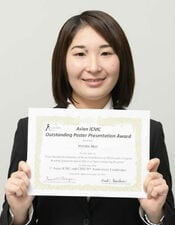
Ms. Haruka Akai
Coinciding with the selection of Sophia University as a funding recipient of the government’s Top Global University Project, its Faculty of Science and Technology started focusing on building a system that accelerates globalization. The efforts are already starting to bear fruit on the world stage in the form of a series of high acclaims received at international conferences by students of the Faculty, including Ms. Akai.
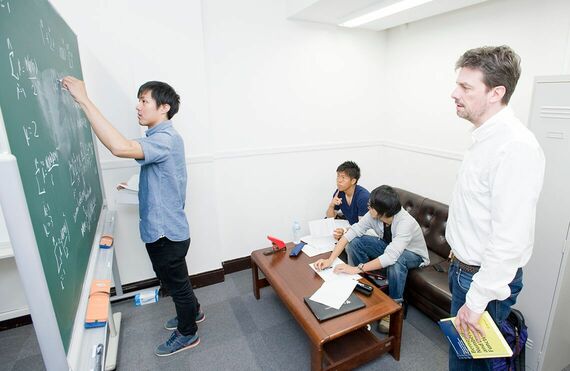
The accomplishment is backed by the Faculty’s unique English language education. For science and technology students, English is an everyday essential required to make presentations at international conferences, read English documents, and write dissertations. In addition to its conventional courses on English as a foreign language, therefore, the Faculty’s second-year students and above are offered systematic education on English as used in the science and technology arena. The aim is to allow students to acquire technical terminology and expressions specific to science and technology as well as discussion and presentation skills.
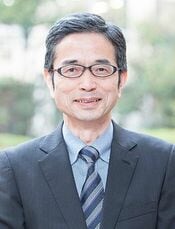
Tetsuhiro Tsukiji,
Dean, Faculty of Science and Technology
Professor Tetsuhiro Tsukiji, the dean of the Faculty, seems content with the results, remarking, “Our Faculty supports female researchers with the aim of thrusting them onto the world stage. The award won by a fourth-year female undergraduate student is indeed a wonderful outcome of our initiative.” He is all the more pleased, he notes, because it has been his long-time wish to foster the next generation of researchers and engineers who will contribute to the development of science and technology from a global perspective.
Diversity offered at a small university where international students gather from around the world
Science and technology faculties of private universities are often located away from the main campus, where other faculties are concentrated. At Sophia University, however, nine faculties including the Faculty of Science and Technology are consolidated at its Yotsuya Campus. Flexibility, a distinctive strength of small universities, is on full display in the global education offered at the Faculty of Science and Technology.
“By being located on the same campus, different faculties can cooperate with one another to facilitate collaboration and information sharing among faculty members, thereby formulating interdisciplinary curricula,” explains Dean Tsukiji. “Sci-tech students therefore can enroll in a wide array of courses offered by other faculties, as well as the Center for Global Discovery and the Center for Language Education and Research.”
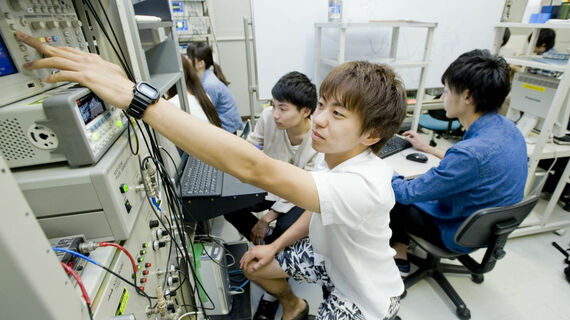
Being a small-sized university, Sophia has a unique advantage in helping students and faculty members with diverse backgrounds interact with one another to encourage in-depth understanding of different cultures and societies around the world. The Faculty of Science and Technology offers courses symbolizing this strength, namely, the Green Science and Green Engineering programs, launched in the autumn semester of 2012 by the Department of Materials and Life Sciences and the Department of Engineering and Applied Sciences, respectively. Both courses are undergraduate degree programs taught entirely in English, including all lectures, labs, and research guidance, and attract international students from across the world.
Furthermore, in the autumn semester of 2013, the Green Science and Engineering Division was established as a graduate program taught entirely in English, meaning that the Faculty offers English-based education at both the undergraduate and graduate levels. In seminars, lively discussions often take place in both Japanese and English. Interactions with English-taught international students help Japanese students use English almost as an everyday language.
According to Professor Tsukiji, in September 2016 the first five students graduated from the English-taught courses, three of whom moved on to Sophia University’s graduate programs and the other two to graduate programs at other universities. In addition, doctoral degrees were conferred for the first time to two students from Thailand and India. Master’s degrees were also obtained by two students from Ethiopia and Columbia after they completed the first half of their doctoral programs.
Close communication brings out the best in students
Along with its diverse student composition, small-group education is another unique feature of Sophia University. At the Faculty of Science and Technology, in particular, three to four students are taught by one teacher in graduate research, which means that the student-teacher ratio is one of the lowest among private universities in Japan. Students therefore find it easy to approach faculty members.
Compassionate and finely tuned teaching motivates students, leading to tangible outcomes, such as the acquisition of patents through lectures. In September 2016, Reo Katayama from the Department of Materials and Life Sciences was granted a patent for a “multi-purpose cutter knife specialized for cardboard box,” which he invented in the course of writing his report for the Faculty of Science and Technology General Subject Group Ⅱ named Intellectual Property Right. Compared with conventional utility knives, the product requires less effort to cut cardboard boxes, such as for recycling purposes. The patent was granted in recognition of its superior convenience and functionality. The Intellectual Property Right course is designed not only to allow students to learn about the systems and laws concerning intellectual property, but also to engage in problem solving and embody ideal technologies. Mr. Katayama was advised by the teacher to actually try cutting cardboard boxes, during which process he became aware of a new challenge he needed to overcome.
Sophia University’s educational system is drawing attention from the industrial community. In recent years, collaborations between industry and academia have been rapidly advancing. In autumn 2014, the Volvo Group, a world-class auto manufacturer, concluded an industry-academia partnership agreement with the university to run internship programs at the Group’s research facilities and plants within and outside Japan. Nissan Motor and Toyota Motor, among a wide range of other companies, are also funding research at Sophia to develop new technologies. Sophia University’s popularity among such global corporations worldwide testifies to the high regard in which they hold its professors and students.
The Faculty of Science and Technology will be celebrating its 55th anniversary in 2017. Sophians in science and technology are sure to continue their evolution to address the increasingly complex and diverse needs of society.
>>>For further information on Sophia University’s Faculty of Science and Technology


