
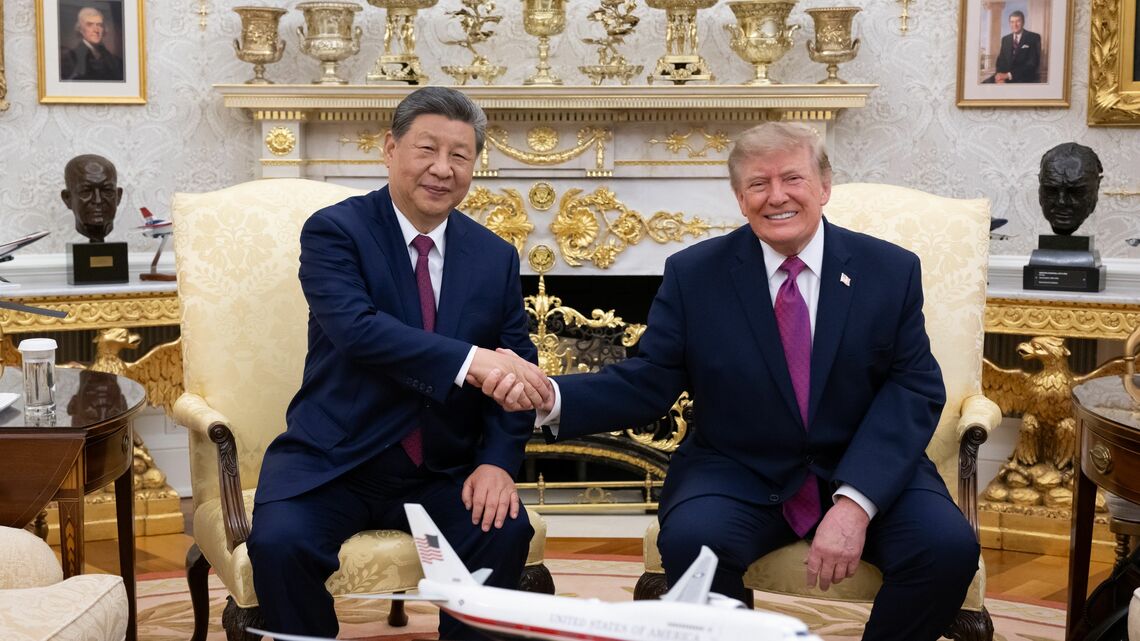
Beyond all the pageantry, the Chinese leader Xi Jinping had a strategic goal for his Washington visit – to undermine the American relationship with Japan. Xi succeeded, perhaps beyond his expectations.
Japanese policy makers saw this coming. They arranged a brief meeting on the sidelines of the United Nations General Assembly between Prime Minister Takaichi Sanae and Donald Trump ahead of Xi’s arrival.
The meeting was empty of content but seemed reassuring. But the next day, Trump welcomed Xi by fondly recalling “the greatness that we had together fighting in World War Two” without mentioning the postwar alliance with Japan.
Xi followed the next day at the official banquet, making clear who was their common enemy. “Over 80 years ago, the Chinese and American people stood shoulder to shoulder in the fight against Japanese militarist aggressors,” Xi said, deliberately obscuring the fact that wartime China was led by the Nationalists, not their Communist foes. The official statements issued by both governments echoed the language of their status as wartime allies.
“Clearly, Beijing would like to drive a wedge between Trump and Takaichi,” respected scholar Mike Mochizuki told Toyo Keizai, “but Takaichi clings to Donald while Donald does not return the favor by calling her Sanae.”
This Chinese use of the wartime past is part of a broader campaign to increase diplomatic pressure on Japan and the Takaichi administration over the Prime Minister’s remarks on a Taiwan contingency and to push the Chinese characterization of Japan’s defense buildup as a renewal of Japanese wartime “militarism”.
Trump, thrilled by his role as a host to Xi, either ignored the Chinese strategic intent, or simply failed to understand the trap he had stepped into.
“Trump’s failure to grasp that the United States had allied with a different China and fought a different Japan will only invite more Chinese coercion,” commented Mireya Solis, the senior Japan expert at the Brookings Institution think tank in Washington.
The Chinese wedge strategy may not be entirely effective. The U.S.-Japan alliance remains anchored in security establishments whose bonds have “deepened enough to prevent a U.S.-Japan estrangement even under Trump,” notes Mochizuki, affiliated with the Quincy Institute for Responsible Statecraft.
But Japanese officials are clearly rattled. The Prime Minister’s office felt compelled to tell the Yomiuri Shimbun that during a short phone call between Takaichi and Trump after the Xi visit, the American president reassured her that he had not sided with the Chinese leader in his criticism of Japan and urged him to hold talks with the Japanese Premier. “I’d be surprised if Trump spoke in detail about Japan with Xi,” a recently retired senior State Department official told this writer.
China’s war on Takaichi
China’s criticism of Japan intensified in response to Takaichi’s victory in the Liberal Democratic Party presidential election last October. Even before her remarks on a possible use of Japanese military forces in a Taiwan crisis, the Chinese were warning about the dangers of her administration as a triumph of the ‘new conservatives’ who favor defense buildup and cultivate close ties to pro-independence forces in Taiwan.
Takaichi’s unapologetic views on the war were well known in Beijing. She made a splash in the Diet early in her career, in 1994, challenging then Prime Minister Murayama Tomiichi for his bold statements acknowledging the war as an act of aggression. Later Murayama issued his statement on the 50th anniversary of the war apologizing for Japan’s “colonial rule and aggression.”
For Takaichi, this was unacceptable. “You can’t just apologize on my behalf without my consent,” she said in the Diet exchange, making it clear that she viewed the war as “legally justifiable.” In a later interview, she pledged to revise the Murayama statement, saying that Japan “fought wars for self-preservation and self-defense.”
When Takaichi met Xi on the sidelines of the APEC summit in Korea in late October, shortly after she took power, the Chinese leader pointedly challenged these views.
“We should widely promote the spirit of the Murayama Statement,” he reportedly told her, “which reflected on the history of aggression and apologized to victimized countries.”
In that sense, Takaichi herself has created the opportunity for China to use the wartime past to try to isolate and pressure Japan.
“Takaichi shares (former Prime Minister) Abe’s revisionist views of history but lacks Abe’s pragmatic and prudent judgement,” says Japan scholar Mochizuki. “So it is not surprising that China has linked Taiwan, Japanese imperialism, and Japan’s defense buildup together to criticize what they see as Japan’s neomilitarism.”
The Chinese use of the wartime past continued with the late September visit of former Foreign Minister Iwaya Takeshi. Chinese Foreign Minister Wang Yi linked the moment to the anniversary of the Tokyo war crimes trials.
"If Japan does not learn lessons from history and challenges the postwar 'Peace Constitution,' tries to revive its history of aggression and resurrect war criminals, it will not even be able to face the world, let alone move toward the future, and it will have no future," Wang said.
Behind this war talk, the Wang Yi talks with Iwaya are an effort to reach out to forces within Japan that believe Takaichi’s anti-China stance, and her overreliance on the relationship with the unreliable Trump, are a mistake. Iwaya, along with former Prime Minister Ishiba Shigeru, is among those clearly opposed to the Prime Minister’s policies toward China. Even more intriguing is the recent interview in Shincho by special advisor Imai Takaya calling on Takaichi to change her language on Taiwan and take a strategic view that does “not rely on the US for everything.”
The upcoming APEC summit meeting in China may provide a window to repair relations. But it will require Japan to act, a Japan that is increasingly isolated by China.
China’s use of the wartime past is nothing new
However the current maneuvers play out, it is important to recognize that the Chinese use of the wartime past is hardly new. In a comparative study of the formation of wartime historical memory that we conducted at Stanford University, our research detailed how the Chinese Communist Party shifted in the last few decades to construct a patriotic narrative to replace one that focused on the struggle against their Nationalist enemies.
In this patriotic narrative, the war serves a dual purpose. Firstly, it allows the current Chinese leadership to assume the role of a great power that helped found the United Nations and was part of a global “anti-fascist” struggle. And it emphasizes the struggle of a unified Chinese people against the Japanese invader, claiming to have been victors in that war.
“There is a growing sense in China that its suffering and its contribution to the overall victory in World War II haven’t been sufficiently appreciated,” historian Rana Mitter, the author of several important books on the war and Chinese memory, told The Wire China in a 2020 interview. “World War II has enabled the state to say, look, this is when China was able to stand up for itself and fight back against invasion.”
In recent years, “history is used by China, including war history and the history of the United Nations, to make the case for Chinese global leadership since 1945,” Harvard Kennedy School historian Mitter told a recent seminar in Europe. The message is that in the current turbulence of the world order, China can play the role it played in 1945 in creating that order.
Beyond the claim to global leadership, the Chinese have not hesitated to use the wartime memories to target Japan.
Last September, the Chinese hosted a huge commemoration of the 80th anniversary, featuring a military parade attended by Russian President Vladimir Putin and North Korean dictator Kim Jong Un. Xi chose this moment to again emphasize the war against Japan and the creation of a “national united front against Japanese aggression established at the initiative of the Communist Party of China.”
Paired with the celebration, the Chinese film industry premiered two slickly produced blockbuster films, both of which were aimed not only at the Chinese audience but also distributed globally, including on streaming services like Netflix. “Dead to Rights” was yet another account of the Nanjing Massacre, done relatively artfully. But “731,” an account of the infamous secretive Japanese biological and chemical warfare unit that performed ghastly experiments on Chinese and foreign prisoners, was directly aimed at Japan. The depiction of Japanese as evil barbarians, and the failure of the United States to prosecute these war crimes, was garishly depicted.
This clash surfaced at the United Nations in what seems like an obscure issue – the existence of a clause in the UN charter which refers to “enemy states,” namely Japan and Germany, allowing the Allied powers from World War II to take action against those former Axis powers without prior Security Council approval. It was designed as a temporary safeguard against the resurgence of militarism but is widely recognized as obsolete and without effect. The General Assembly voted twice to remove the clause but it requires an amendment of the Charter that China and Russia can block.
Prime Minister Takaichi called on the UN to remove this clause. After her address to the General Assembly, China’s deputy ambassador to the UN, Sun Lei, defended its existence, pointing to “proof that Japan’s re-militarization has become a real threat to regional and global peace and stability.”
These history wars are decades long, and they shift in response to the needs of foreign policy, in both Beijing and Tokyo. China has played the history card, again, and it remains to be seen how Japan will respond. For Japan, the U.S. under Trump is increasingly an unreliable actor. But however this plays out, the past will never really be forgotten.
