
New Prime Ministers in Japan often come into office promising grandiose achievements that they don’t come close to realizing. Shinzo Abe promised 2% annual real growth. Fumio Kishida promised to reverse the decline in households’ share of national income. Now it’s Sanae Takaichi’s turn to serve pie-in-the-sky. Her recent honebuto proposed a 15-year ¥370 trillion public-private investment scheme that she claims will double average real GDP growth to 1.4%.
Her investments are not going to happen. If they did, it would make things worse because most of the 17-sector projects are just high-tech “bridges to nowhere.”
Takaichi claims companies invest too little and wants them to furnish ¥300 trillion for her plan beyond that normal investment. But if companies saw profitable opportunities to invest more than they already do, they’ve got plenty of money. Currently, corporate cash flow exceeds their investments by a huge 7% of GDP (see chart below), and the retained earnings parked in their digital vaults now equal a year’s worth of GDP.
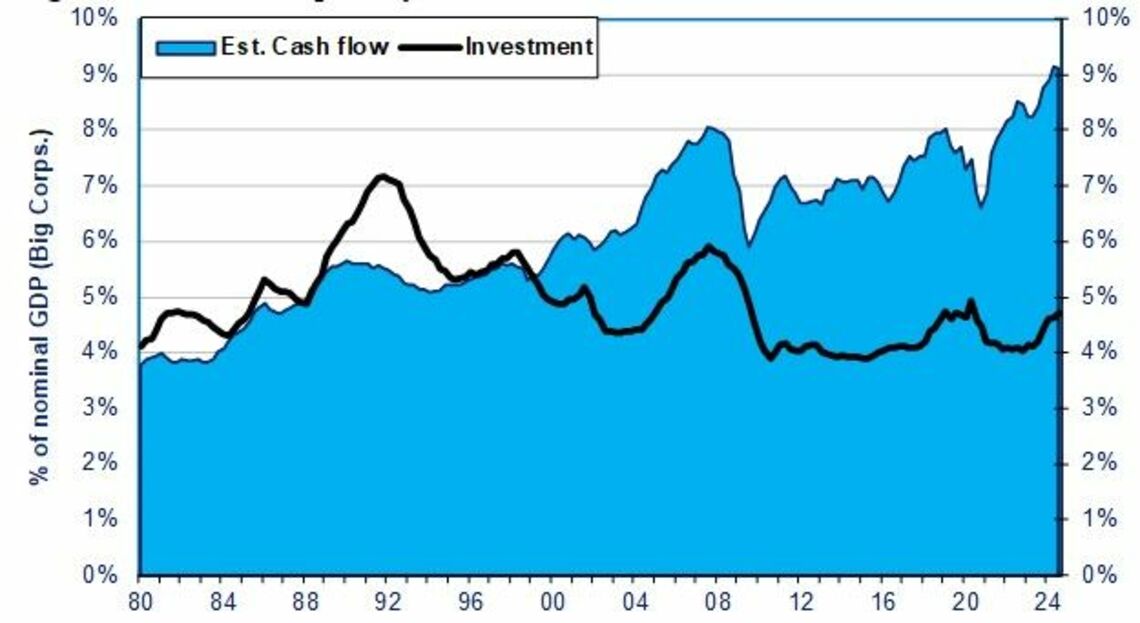
That’s money lying fallow. In effect, companies depress the economy by withdrawing more purchasing power than they plow back via increased wages, investment, and taxes. To keep the economy out of recession, the government has to act as the “buyer of last resort.” In fact, government spending has accounted for a stunning 45% of all GDP growth from 2015 to today.
Takaichi fails to ask why companies are hoarding so much cash. Companies don’t expand capacity unless demand for the additional products exists. But because real wages have stagnated and social security has been cut, real consumer spending is no higher than it was in 2013. And, despite the ultra-weak yen, exports have not expanded enough to fill the gap.
Takaichi may fantasize that her plan will stimulate new investment, but that depends on her promise of unrealistically huge returns on the investment, returns that the corporate “bean-counters” Keiriyā are not likely to buy.
Undoubtedly, there are some worthy programs within the 17 sectors, including research on perovskite solar cells, batteries, and green hydrogen for hard-to-abate sectors such as steel. Steel alone accounts for 14% of Japan’s carbon emissions. However, such cases are joined by boondoggles for sectors like port logistics and even animation. Even when the targets are worthy, the claimed economic payoffs are grossly exaggerated (see chart below).
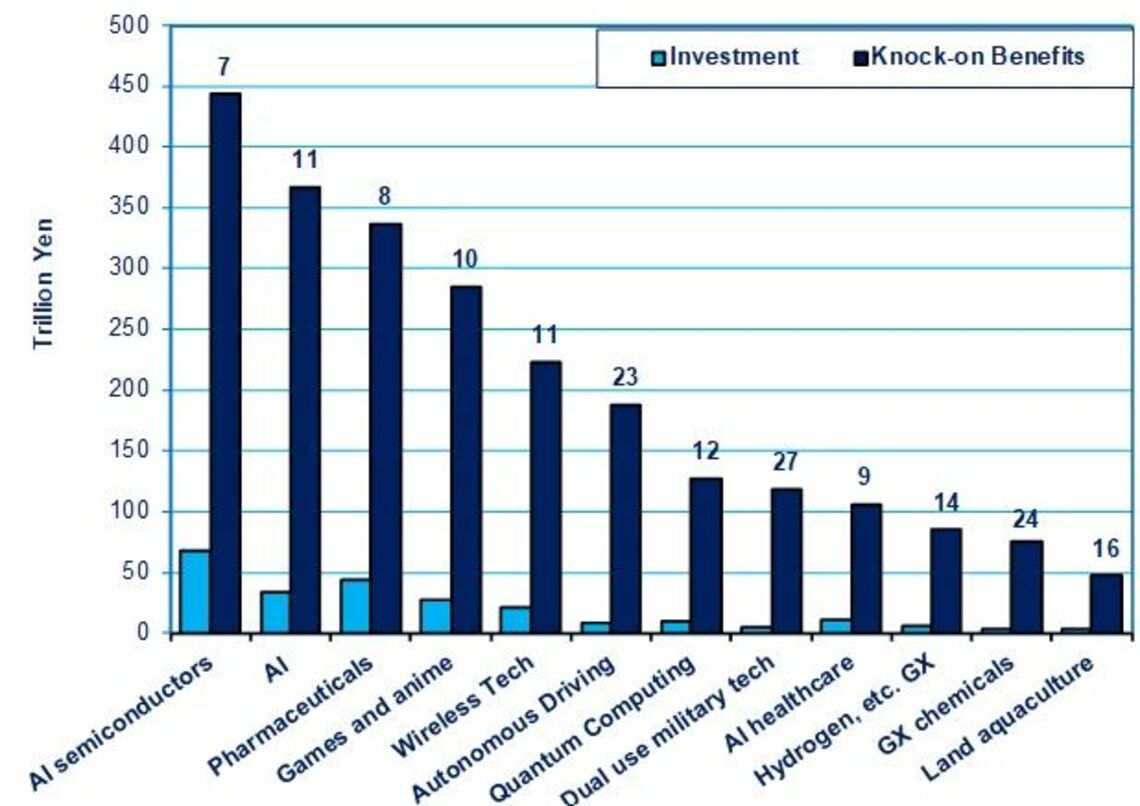
It is claimed that ¥8 trillion invested in autonomous driving will add 23 times as much—¥187 trillion—to GDP over the coming 15 years. Given Japan’s poor performance in software, can Japanese automakers really challenge companies with a proven track record like Google’s Waymo? Each Waymo processes 20 gigabytes per second, turning such “big data” into driving instructions. By contrast, on a measure of the ability to use “big data,” Japanese companies rank 56th out of 58 countries, according to IMD’s 2025 World Digital Competitiveness Ranking.
AI is too new to predict its benefits or which companies will succeed and Japan lacks enough qualified technologists in this area. So, how can Tokyo tell us that a country lagging in software can turn ¥34 trillion invested in AI into ¥366 trillion in additional GDP?
¥44 trillion invested in pharmaceuticals is supposed to boost GDP by ¥385 trillion, even though the global share of Japanese drug companies has plunged from 18% in the 1990s to 4% today. Can ¥68 trillion invested in AI semiconductors grow into ¥443 trillion when the global market share of Japanese-made chips has collapsed from half in the 1970s to less than 10% today?
Some investments will actually depress GDP. Using carbon capture and co-firing to prolong the use of coal and gas will saddle Japan with high-cost electricity. Tokyo wants more funds for Rapidus, a public-private company that hopes to compete with Samsung and TSMC on chips of 2 nanometers or less. Many experts doubt Rapidus will ever turn a profit. This is money down the drain. Japan benefited more from getting TSMC to build its own plant in Kyushu.
To Ending Corporate Cash Hoarding and Promoting Growth
If the goal is to remedy the drain on growth caused by so much fallow cash lying useless at companies, the more effective path is to reduce excess cash by redirecting it. This is eminently realistic.
The primary reason corporate cash flow is so high is that wage suppression has reduced labor’s share of nominal business GDP from 70% during 1995-2003 down to 59% at present. Revitalization requires substantial, steady real-wage increases. Increased consumer purchasing power would not only boost growth directly but also give companies a reason to invest more. Although nominal wages have risen in recent years, real wages kept on falling until the last few months.
Unfortunately, Takaichi’s plan includes nothing on the wage front besides offering the failed trickle-down promise that more investment will raise wages.
Over the last 15 years, the most effective measure has been steady minimum-wage increases of around 3% per year. Over a couple of decades, this has lifted almost 20 million workers above levels close to, or even below, the poverty level. The hourly minimum is expected to rise to ¥1,176 this fall, and Prime Minister Shigeru Ishiba targeted ¥1,500 by 2030. Takaichi, by contrast, proposes to push that back to as late as 2035. About 28 million Japanese employees—almost half the labor force—earn less than ¥1,500.
At the same time, Tokyo needs to enforce Japan’s laws mandating equal pay for equal work between men and women and between regular and non-regular workers. Non-regular workers earn an hourly wage 40% lower than regular workers. Meanwhile, women in the same occupation as men face wage discrimination.
Over the past couple of decades, Tokyo has repeatedly shifted income from households to companies by raising the consumption tax while cutting corporate taxes. Keidanren and METI claimed that everyone would benefit because companies would use the extra retained earnings to spend more on wages and investment. However, corporations never fulfilled their end of the bargain.
From 1994 through 2024, the pretax income of nonfinancial corporations more than quadrupled as a share of GDP, from 4% of GDP to a shocking 18%. But because of the tax cuts, corporate tax revenue stayed flat relative to GDP. In 2024, it amounted to just 3.3% of GDP. Without the tax cuts, profits that high would have produced nearly 10% of GDP in tax revenue.
A final measure is to increase middle-class shareholding so a larger share of corporate profits becomes income for consumers. Japanese household dividend income is a tiny sliver of national income, i.e., less than 0.5% of GDP.
The new version of the tax-free NISA stock market accounts launched in January 2024 is an attempt to do so. But it seems as if people are buying NISA accounts by selling taxable stocks rather than putting in new money. The evidence is that the household share of all stocks has not yet increased. The share remains at 17%.
In addition, corporate governance reform should encourage companies to return more money to investors through dividends. Despite talk of companies paying more dividends, the share of net income that corporations return to shareholders, i.e., the “dividend payout ratio,” has barely risen from a decade ago, from 31% to 34%.
In recent years, activist investors have pushed hard for companies that cannot use their cash pile to return it to investors. Takaichi has disparaged this as paying too much attention to shareholders rather than investing it in new plant and equipment. Really? Do we really want automakers and steel companies to expand capacity when auto sales are down 14% from 2007? Steel sales at home and abroad are down. For the economy as a whole, it makes much more sense to reallocate capital to companies that can use it better rather than either hoard it or invest it in low-return projects. In fact, one of the major functions of the secondary market since stock markets began is such reallocation.
As I detailed in this post, one of the biggest reasons for Japan’s low growth is that it suffers from too little reallocation of capital and labor. Unfortunately, Takaichi is backing away from the reforms needed to improve reallocation. Nicholas Benes, head of the Board Director Training Institute of Japan (BDTI), points out that, “Clearly led by the LDP, the MOJ [Ministry of Justice] has floated several amendments to Japan's Companies Act…which by open admission are intended to lessen the ‘pressure’ from activism that Japanese companies are now feeling.” Benes says these moves by themselves “might not make a big difference” but, when combined with proposals by the Ministry of Economy, Trade, and Industry (METI)’s “recent re-interpretation of its Takeover guidelines, they create the impression that Japan is backsliding on reform.” For details of Benes’ analysis, see his LinkedIn post.
This backpedaling is more likely to increase the Himalaya of retained earnings than spur new investment. By favoring old incumbent firms regarding wages and governance, she’s unwittingly strengthening the very flaw she wants to remedy.
