
There’s good news for the 70-77% of Japanese voters who worry that the proposed two-year cut in the food tax will lead to cuts in social security and/or endanger Japan’s fiscal health.
Firstly, the recent rise in interest rates on long-term Japan Government Bonds (JGBs) is not being caused by the proposed tax cut. Rather, it’s a continuation of the years-long normalization of interest rates.
Secondly, the government could easily pay for the tax cut by rolling back some of the huge cuts in corporate taxes made over the past few decades. Unfortunately, the Liberal Democratic Party will resist using this resource.
In 2021, Prime Minister Fumio Kishida had talked about a bit of a rollback to help pay for his hike in defense spending, but he quickly abandoned the idea under pressure from METI and Keidanren. Now, Sanae Takaichi does not even mention the possibility. Instead, she proposes to raise income taxes on people by 1 percentage point in each tax bracket.
Let’s look first at the interest rate situation. Sensationalist articles in the press and social media headline that 10-year JGB interest rates are the highest since 1996. But that’s a meaningless comparison since the Bank of Japan (BOJ)’s move toward zero overnight rates began in 1995. So, the rise today is mostly due to the BOJ’s normalization of rates.
As shown in the chart below, despite Takaichi’s fiscal largesse, there has been no explosion of interest rates. On the contrary, the curve in the trendline shows that pace of the rise has actually begun to level off in the last few months. Interest rates today are right on the trendline (the dotted line in the chart).
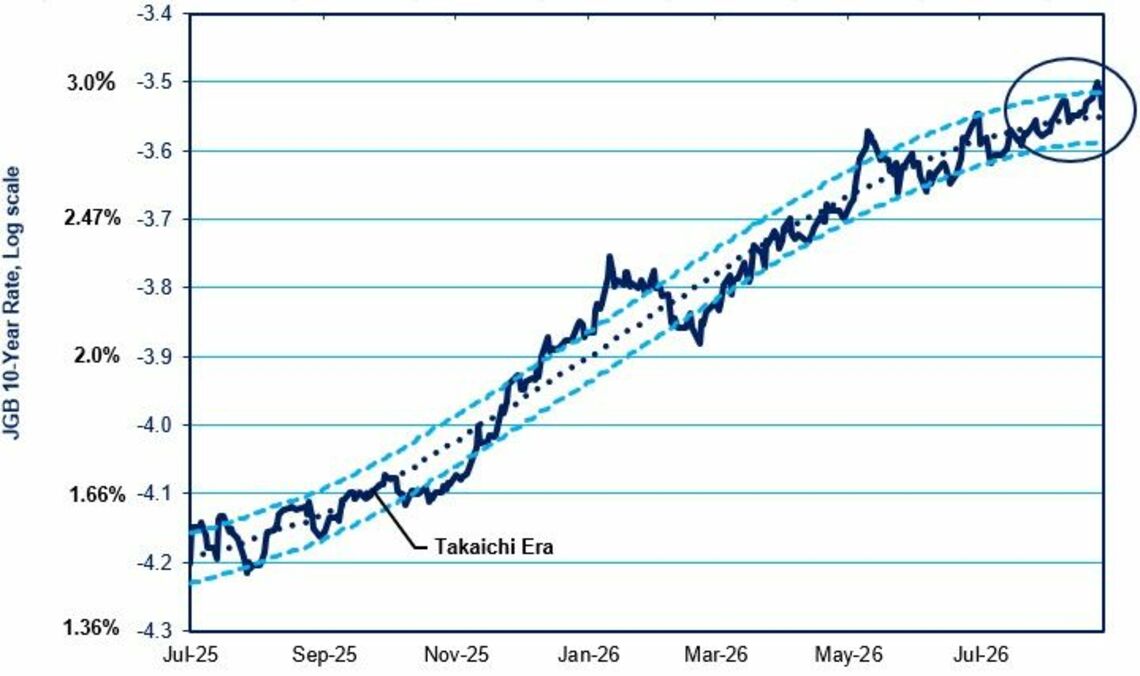
To get a better look at the actual trend, I’ve used a logarithmic scale so that, every time the interest rate rises by four horizontal lines, that means a 50% hike in the interest rate, e.g. from 1.36% to 2.0% or from 2.0% to 3.0%. If I showed a chart from early 2024, when the BOJ stopped controlling 10-year interest rates, the trendline exhibits a constant pace in the rise of yields, with no pickup in the Takaichi era.
There is certainly no guarantee that JGB rates will stay in this pattern. But, so far, months of doomsaying about rates being out of control have failed to come true. Nor do Japan’s leading financiers expect any sort of JGB panic.
In fact, when the BOJ surveyed 77 major financial institutions in August, including some involved in the JGB auctions, the average respondent predicted that the 10-year JGB yield would stabilize at around 3.0% through March 2029. Half of the respondents believed the yield in March 2029 would range between 2.75% and 3.25%. Only 8% believed the yield would surpass 3.5%.
How high would the yield have to go before it would surpass “normal.” No one really knows. The yield we see in the newspaper consists of two parts. One part is the interest that investors need just to reimburse them for the inflation rate that they expect over the coming ten years.
Over June through August, investors expected inflation to hold steady at 2%, which is consistent with the BOJ’s goal of sustainable 2% inflation. At the end of August, the remainder of the nominal yield was 0.9%, which is the “real” after-inflation cost of capital.
Since it’s been three decades since Japan had normal market-determined interest rates, no one knows what “real” rate accords with today’s economic fundamentals. Nonetheless, a real rate less than 1% does not bespeak a market spooked by worries about a budget crisis.
As reassuring as all that is, voters are right to demand that the government say how it intends to pay for this tax cut. The good news here is that there is no economic obstacle preventing the government from finding a tax revenue source to pay for the cut in food taxes.
That source is rolling back some of the enormous tax cuts Tokyo has given to corporations over the past few decades, cuts that have not provided any benefit in either higher wages or more business investment. The bad news is that political leaders lack either the courage or the desire to take advantage of this source.
Over the past four decades, the government has repeatedly shifted the tax burden from companies to consumers. At the same time that the government repeatedly hiked the consumption tax, it repeatedly reduced corporate profits taxes. The average effective rate plunged from 53% in 1994 to around half of that in recent years.
To make matters worse, because these companies have not raised wages since the mid-1990s, profits of non-financial corporations skyrocketed from 4% of nominal GDP in 1994 to 18% today. But taxes paid by these corporations flatlined as a share of GDP.
Today, corporate taxes are just 3.3% of GDP. If not for the tax cuts, the revenue from corporate taxes would be around 9.2% today (see chart below). That’s a ¥37 trillion gap between how much companies actually pay today and how they would have paid without the tax cuts.
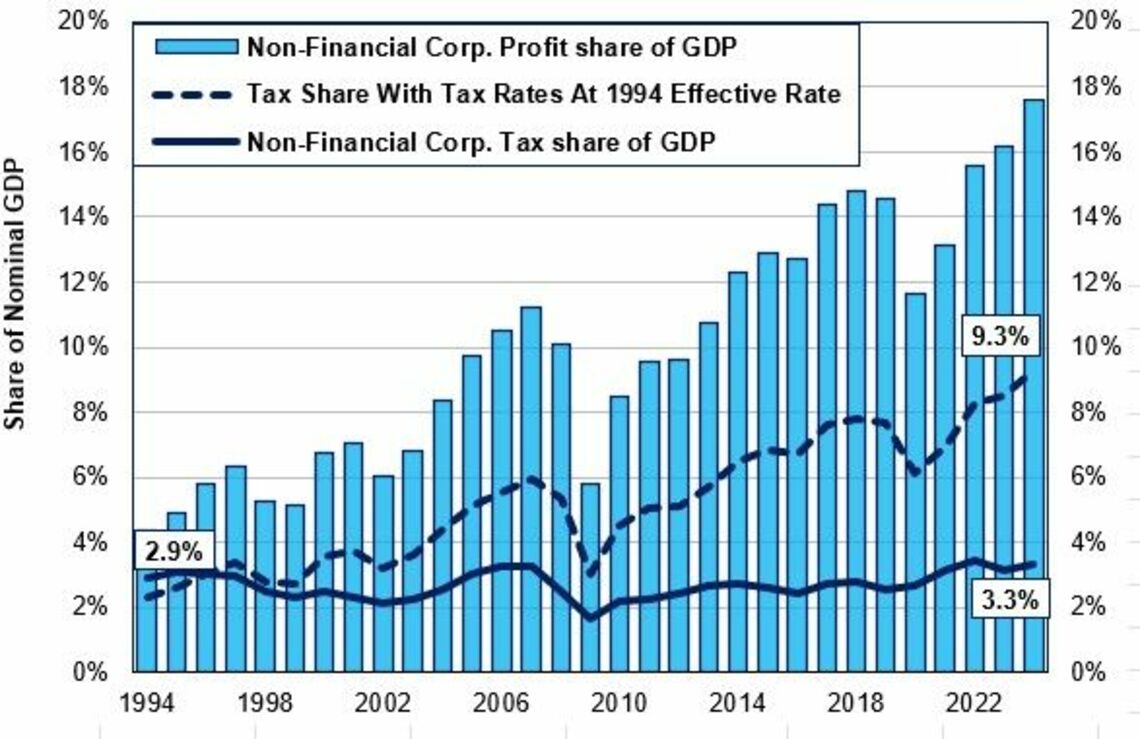
By contrast, the 8% tax on food brings in revenue of just ¥5 trillion per year. So, Japan could pay for the entire temporary tax cut without much a tax hike on companies.
Why did Tokyo cut corporate taxes at all? Keidanren and METI claimed that, if the government cut their taxes, they’d use the extra money to raise wages and to invest more. But companies never kept their part of the deal. Between 1996 and 2026, the 36 million workers at Japan’s 900,000 companies saw virtually no nominal increase in wages per worker.
At the same time, investment in plant, equipment, and R&D by these companies remained at the same 8% share of GDP that has prevailed for most of the past 45 years. So, if cutting taxes did not improve the wage and investment situation, reversing a bit of those cuts won’t hurt either wages or investment.
When Kishida decided to double defense spending from 1% of GDP to 2% in 2021, he raised the possibility of rolling back part of the corporate tax cuts. In fact, at a November 2021 meeting of Kishida’s New Capitalism Council, participants were given materials showing that, between 2000 and 2020, the yearly profits of Japan’s 5,000 largest corporations almost doubled but their compensation to workers fell 0.4% and their capital investment fell 5.3%.
Instead of investing in Japan’s workers or capital stock, these companies have just hoarded cash in their digital vaults. As of April-June 2026, their mountain retained earnings added up ¥672 trillion, an amount equal to a year’s GDP.
When I spoke to a senior METI official about this during the Kishida era, he said the Ministry’s top priority was to prevent any roll back of the corporate tax cuts. METI and Keidanren succeeded and Kishida caved. When opposition parties campaigned in 2024 and 2025 on proposed cuts in the consumption tax, I suggested that they needed to say how to pay for the cuts and mentioned the corporate tax. All of the opposition parties evaded the issue.
Whereas Kishida at least considered reversing some of the corporate tax cuts, Takaichi has instead proposed by raising the income tax on people by 1 percentage point across all tax brackets. But raising the tax rate from 5% to 6% is a bigger proportional hike than raising it from 23% to 24%.
