
Twenty years have passed since Hitachi first secured an order for high-speed rolling stock in the UK. Railway business sales have finally surpassed ¥1 trillion — 90% of it earned overseas.
The road here was long.
In 2015, Hitachi acquired Italy's Ansaldo STS, a major railway signaling manufacturer, and AnsaldoBreda, which handles rolling stock. In 2024, it completed the acquisition of Thales's signaling business, the French defense and aerospace group.
Signaling and control systems now account for 60% of the railway business, helping drive sales to ¥1.194 trillion for the fiscal year ending March 2025 — the first time the business has crossed that threshold.
Order Backlog Climbs to ¥6.2 Trillion
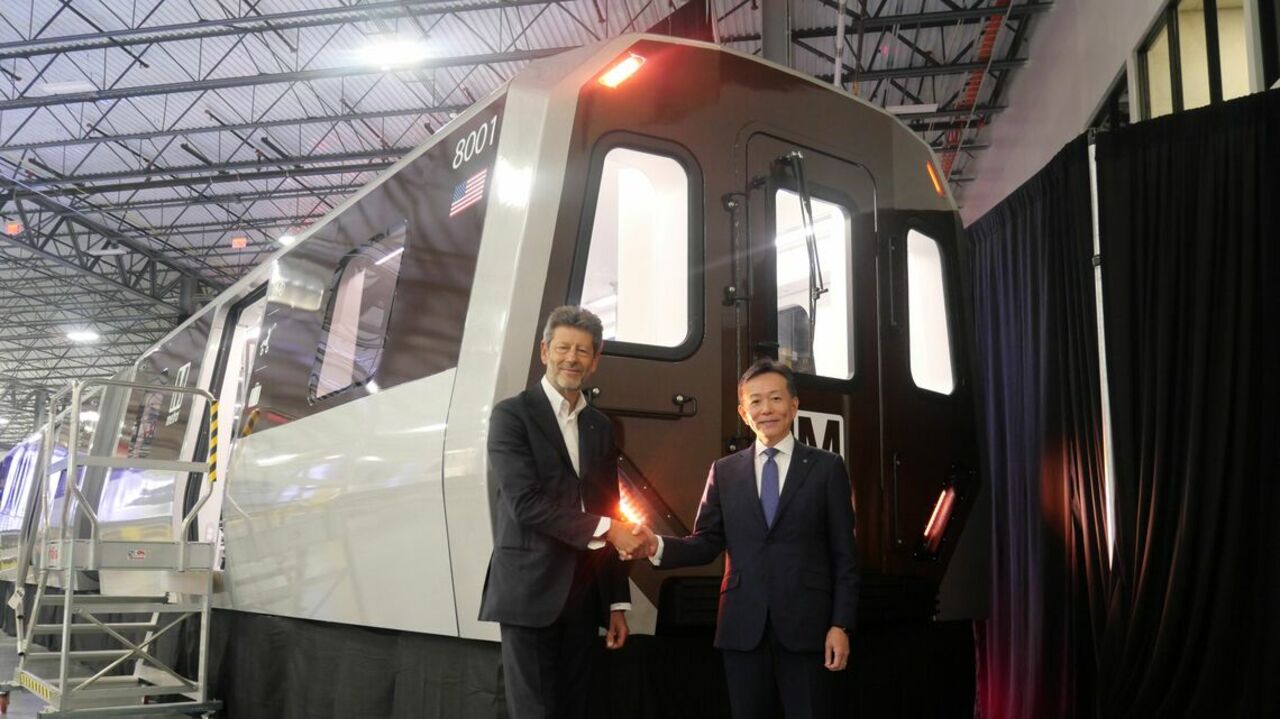
Hitachi's railway business now spans 50 countries, with 10 production sites and 25 R&D centers. Giuseppe Marino, CEO of Hitachi Rail, has led the division since April 2023 — an Italian national who came from AnsaldoBreda. The rolling stock being assembled at the new Heagerstown plant was designed by the development team at Hitachi's Italian base.
One Italian media outlet described the new plant as "a fusion of Italian design and engineering with Japanese manufacturing technology." The workforce on the factory floor is, indeed, multinational.
The business environment is favorable. With a global modal shift underway — driven in part by environmental concerns — passenger numbers are expected to keep growing. Hitachi's order backlog had reached ¥6.2 trillion as of the end of May 2025. The company is targeting sales of ¥1.4 trillion for fiscal 2027 and ¥2 trillion for fiscal 2030.
One key strategy for hitting the ¥2 trillion target is expanding in priority and growth regions. Historically, over 60% of railway revenue has come from Europe. Germany remains a strategic focus under the medium-term plan through fiscal 2027, but Hitachi is also eyeing expansion in the Middle East, India, and the Asia-Pacific region.
North America, meanwhile, accounts for only around 8% of sales — approximately ¥90 billion for the fiscal year ending March 2025. Hitachi describes North America as "one of its key growth markets" for rail, but just how much room is there to grow?
Riding America's Infrastructure Wave
One potential source of opportunity is the $1.2 trillion Infrastructure Investment and Jobs Act, passed under the Biden administration in 2021. With America's infrastructure aging, the Act allocates $550 billion by 2029 for roads, bridges, urban public transit, and passenger rail.
Concerns have emerged about project delays under the Trump administration, but Senator Chris Van Hollen (D-MD), who sent a video message to the factory opening ceremony, noted that the law "has enabled historic investment in all forms of transportation and infrastructure over the past four years."
With infrastructure investment momentum building, Hitachi is also benefiting from the strengths of its acquired companies. "In the subway market we've been focusing on, we have a pretty good track record of winning contracts," said Hidetoshi Miura, Senior Director of Hitachi Rail USA.
The new plant is currently producing railcars for the Baltimore Metro, with plans to manufacture subway cars for Washington, D.C., and Pennsylvania as well.
Randy Clarke, CEO of the Washington Metropolitan Area Transit Authority (WMATA), explained why the authority chose Hitachi. "Metro wanted a factory built in the region to drive economic development," he said. "Hitachi came with a great proposal — not just to deliver a vehicle, but to put together a facility like this that contributes to our regional economy."
On what set Hitachi apart, Clarke was equally clear. "I'm not sure I'd call it a surprise, but what I found was reassurance — how committed they are, and the level of investment in technology and understanding the future of what we're trying to do as a partnership."
The base contract between Hitachi and WMATA covers 256 cars, but can be expanded to as many as 800 depending on demand — potentially worth up to $2.2 billion. Clarke sees the additional cars coming not so much from replacing existing stock, but from running more trains.
"One of the challenges in the coming years is reducing headways from 10 minutes to 8, and eventually to 6. That will require more cars — track capacity issues aside."
The new factory, bringing together technology and services from across the Hitachi Group, will be central to winning customers across North America. "This facility will serve as a base where not only our customers, but also government officials and partners, can see firsthand what Hitachi is capable of," said Toshiaki Tokunaga, President and CEO of Hitachi.
Beyond the Sale: Making Money from Maintenance
Hitachi is also working to shift toward a recurring revenue model by providing software and services to railway operators.
A key focus is expanding the adoption of HMAX, its solution for maintaining and managing trains, signals, and infrastructure. The system collects data from sensors installed on rolling stock and infrastructure, analyzes it using AI, and alerts operators to any issues. It has already been deployed on 2,000 trainsets and 8,000 cars of Hitachi rolling stock, primarily in Europe.
"Our contracts with railway companies cover a wide range, but we are sensing a gradual increase in demand for maintenance and operational services — things like monitoring and understanding the condition of assets such as infrastructure," said Nadia Mazzino, Senior Director at Hitachi Rail.
The backdrop is a combination of aging infrastructure and a shortage of skilled maintenance workers. Even as the global modal shift gathers pace, the physical infrastructure supporting it is growing old — the UK's railways, for instance, are approaching their 200th anniversary. A severe labor shortage is making it increasingly difficult to carry out adequate maintenance, including overnight repair work.
"Tracks expand and contract with changes in climate and temperature," explained Koji Agatsuma, Hitachi Rail Executive Director and CTO.
"By checking their condition every day, we can immediately detect when something is off — even under the same weather conditions as usual." Timely maintenance, he noted, helps avoid unexpected disruptions such as sudden service suspensions.
Customers can select the services they need from within the HMAX solution — covering maintenance and management of signals, overhead lines, substations, and energy systems. Data sharing across systems is also possible, which proves useful given that the condition of rolling stock and infrastructure can often be interrelated.
What the Nvidia Partnership Changes
Driving HMAX's development is a collaboration with U.S. semiconductor giant Nvidia. When using onboard cameras to analyze the condition of overhead lines and other infrastructure with AI, Nvidia's GPUs can process massive volumes of data in a fraction of the time previously required.
"Analyzing two million hours of data would take three months on a CPU, but just three days with a GPU," said Agatsuma. Hitachi is also developing services that instantly flag abnormalities in rolling stock and infrastructure by mounting Nvidia systems directly on vehicles.
To strengthen data collection, Hitachi Rail announced in January the acquisition of Omnicom, a UK company with proprietary sensor technology developed specifically for the railway sector.
At an investor briefing in June, Marino outlined the opportunity: "HMAX has tremendous potential. As of the end of May, we have secured ¥20 billion in orders and built a ¥200 billion pipeline." Whether the platform can demonstrate returns that justify implementation costs will be the key to realizing that potential.
This article is part of "Hitachi's Global Ambitions," a special feature originally published in Toyo Keizai from July to November 2025. English edition prepared for The Oriental Economist.
