
Hitachi's power grids business is booming.
Revenues at Hitachi Energy, the group subsidiary that runs the business, rose 30% year-on-year to ¥2.3955 trillion in fiscal 2024. Adjusted operating profit — revenue minus cost of sales and SG&A — surged 1.7 times to ¥257.6 billion.
The division now accounts for roughly 26% of Hitachi Group's total adjusted operating profit.
A $50 Billion Backlog
"The energy market is not just growing; it has doubled in size from $105 billion in 2017 to last year, and is expected to reach $450 billion by 2035. It is unclear whether 2035 will be the peak, and there is potential for further growth."
At an investor briefing held in mid-June, Andreas Schierenbeck, CEO of Hitachi Energy, made these remarks.
In July 2020, Hitachi acquired ABB's power grids business for approximately ¥1 trillion (fully consolidated in July 2022) and integrated it into its own power grids business.
The company now handles everything from manufacturing grid-related equipment needed to deliver electricity from power plants to consumers to maintenance and operations, making it a comprehensive player in the industry.
As of the end of the first quarter of the fiscal year ending March 2026, its order backlog had reached $47.6 billion, with contracts secured for the next six years, indicating exceptionally strong demand.
The equipment handled by Hitachi Energy is inherently less susceptible to bubble-like fluctuations, given its long product lifecycle. At the same time, aging power infrastructure — particularly in the United States — is generating strong replacement demand.
On top of this, two major trends are driving growth.
The first is decarbonization. According to the IEA's Global Energy Review 2025, electricity generation in 2024 increased 4.2% year on year. Generation from renewable sources such as solar has grown significantly, with renewables now approaching coal in terms of share of total generation. Given rising environmental awareness and improving cost competitiveness, this trend shows no sign of slowing.
Energy companies — Hitachi Energy's core customers — are investing heavily in new power sources. But renewable energy projects, such as offshore wind, are typically located far from demand centers. This necessitates transmitting large amounts of power efficiently over long distances.
That is where high-voltage direct current (HVDC) transmission comes in, and Hitachi Energy holds the top global market share in this field. HVDC has historically been most advanced in Europe, where cross-border power trading is well established — but Hitachi Energy is also winning orders in China and India, where large-scale projects are multiplying.
Energy Demand Picks Up in Developed Countries
The second trend is the expansion of energy demand.
According to the IEA, energy demand grew at an average annual rate of around 1.3% over the ten years from 2013, driven by rising electricity consumption in China and India, the spread of electric vehicles, and the electrification of manufacturing processes.
In 2024, that figure jumped to 2.2%. Climate factors played a role, but the more significant shift is that energy demand has begun to rise again in developed countries. In the EU, demand increased for the first time in seven years, and the U.S. saw demand growth that ranked third globally, behind only India and China.
The driving force is data centers — and above all, AI. Data centers had already been growing on the back of cloud adoption and digital transformation, but AI has been the real game-changer.
Schierenbeck made no effort to hide his surprise. "Data centers, yes — but AI data centers coming in with this level of power consumption, nobody expected that," he said.
"Nobody expected that these customers would show up needing 500 megawatts or one gigawatt. Data centers used to mean 10, 20, 30 megawatts — not a big problem for the grid."
If the AI trend continues, the IEA projects that global electricity consumption by data centers will reach 945 billion kilowatt-hours by 2030 — double the 2024 level, and roughly equivalent to Japan's entire current electricity consumption.
"We did not anticipate that data center electricity consumption would increase the way it did — but the hyperscalers also overlooked the need for power supply," Schierenbeck added.
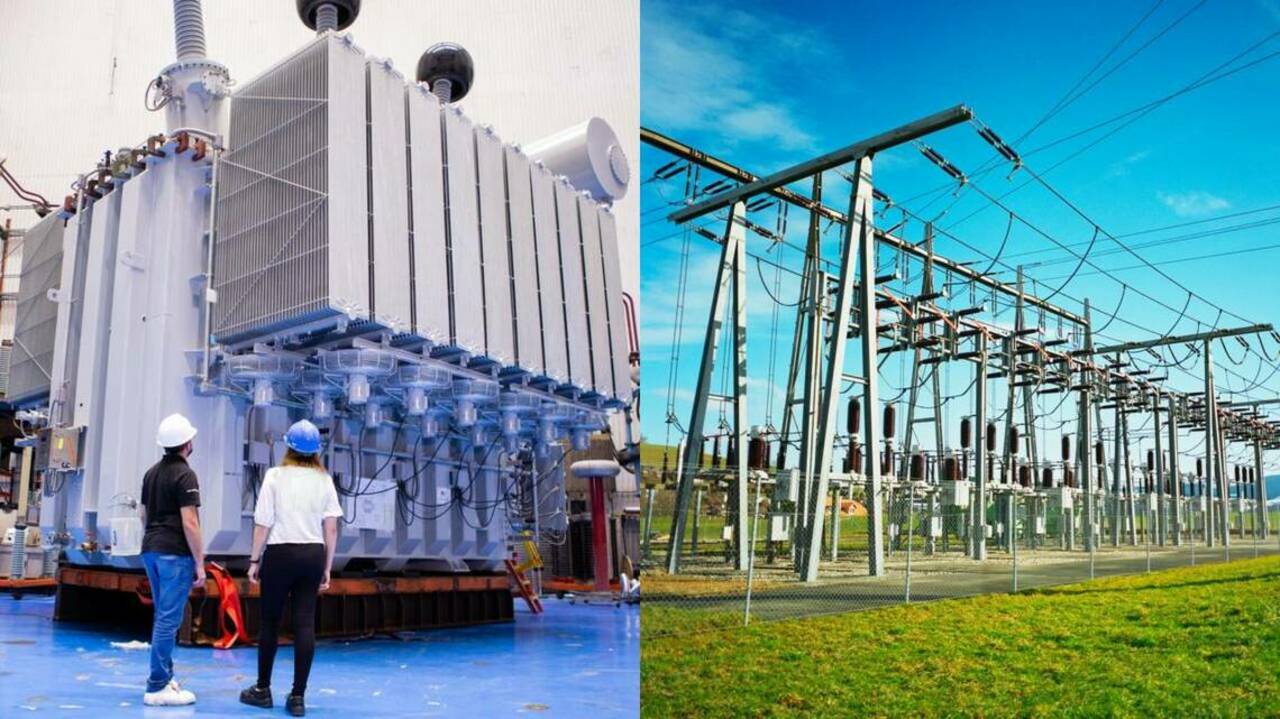
Transformers reduce the high-voltage electricity generated by power plants to levels suitable for use by factories, businesses, and homes. As data centers continue to proliferate, the risk that transformer production will fail to keep pace is becoming very real.
A Japanese transformer manufacturer put it plainly: "We were already scrambling with the shift to renewables, and then AI piled on all at once."
The Race to Build Capacity
Hitachi is also the world's leading producer of transformers. With demand for transformers running hot alongside HVDC, Schierenbeck says, "With our current production capacity, we cannot fulfill all of our order backlog."
Hence, the investment program that Schierenbeck describes as "one of the biggest the industry has ever seen."
Hitachi Energy has already invested $3 billion between 2020 and 2023. For 2024 to 2027, it plans to double that to $6 billion (approximately ¥880 billion) — a figure that puts the scale in perspective, given that Hitachi Group's entire growth investment under its previous medium-term plan was ¥800 billion.
Initially, Hitachi Energy announced $1.5 billion in investment to expand transformer production capacity, including new factories in Finland, China, and Vietnam, as well as expansions in Germany and the U.S., starting in 2024.
Then, in June last year, the company decided on an additional $4.5 billion. This includes expanding two U.S. factories for $155 million and establishing a new factory in Mexico, while urgently ramping up transformer capacity in Europe and India.
And in March this year, a further $250 million was added — taking the total beyond the original $6 billion framework. Whether it will be enough to address the serious transformer shortage remains to be seen.
Schierenbeck acknowledged the complexity: "Transformer factories require special equipment — floors that can withstand 450 metric tons, 250-ton cranes. There are not many companies that can build such facilities."
But he expressed confidence in the execution. "We have all the necessary machinery in place, and our construction partners understand what we need. Because we are expanding in smaller increments, at different times and in different countries, I think we are doing rather well on that front."
Pivoting Toward "Service First"
Driven by strong demand, Hitachi Energy has set an ambitious target of $30 billion in revenue by 2030 — nearly 90% growth from fiscal 2024. For medium- to long-term growth, the company is looking to services such as the maintenance and operation of grid-related equipment.
Currently, Hitachi Energy has an installed base of approximately 500,000 units, but its service contract rate is less than 1%. The plan is to grow that fivefold in the medium term, including through M&A, raising services to around 25% of total revenue.
Central to this is Lumada, Hitachi's DX platform, which is already being used in the power grids business for lifecycle management of customer equipment. The "Lumada 3.0" initiative, launched this spring, aims to combine Hitachi's domain knowledge — its accumulated experience and expertise — with AI to solve customer challenges.
As Lumada gains traction, it should not only improve operational efficiency but also increase the proportion of higher-margin business. Even as it rides the wave of surging electricity demand, Hitachi Energy is steadily laying the groundwork for its next chapter as a service-first enterprise.
This article is part of "Hitachi's Global Ambitions," a special feature originally published in Toyo Keizai from July to November 2025. English edition prepared for The Oriental Economist.
