
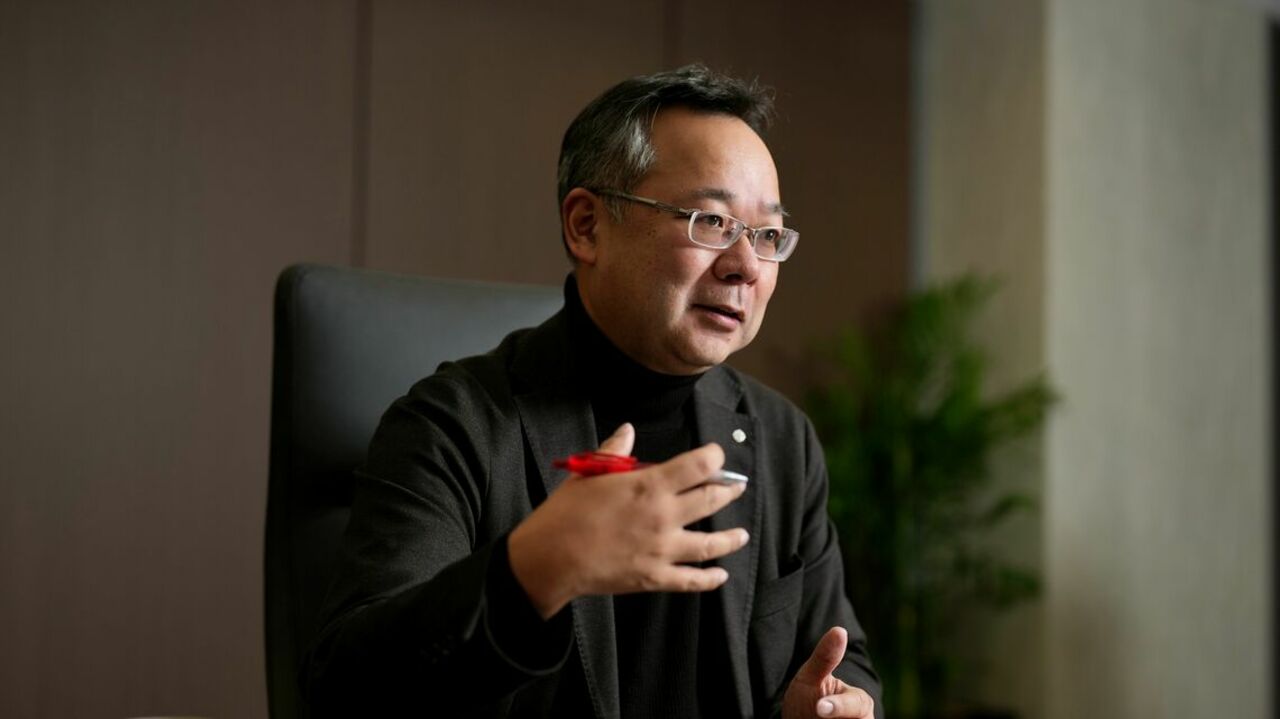
As Hitachi pushes to expand its services business with digital at its core, the company’s corporate culture is also undergoing a significant shift.
What is happening at the front lines of its digital business? How is the relationship with GlobalLogic, the digital engineering firm Hitachi acquired in 2021 for ¥1 trillion, evolving?
We spoke with Jun Taniguchi, head of the Strategic SIB Business Unit, based in Silicon Valley and leading the development of new businesses.
Since Toshiaki Tokunaga became president and CEO last April, what changes have you seen?
Tokunaga comes from a digital background, and that has made the company’s direction clearer. The idea of becoming a “digital-centric company” that creates value through AI and digital technologies—through initiatives such as Lumada 3.0, the DX support business, and HMAX, its AI-powered digital services—has become more pronounced.
There is a stronger sense that Hitachi aims not only to provide AI-based technologies but also to apply them itself in delivering services and solutions.
One thing Tokunaga places great importance on is speed—making decisions on the spot and acting immediately. I feel that this mindset is now steadily spreading across the entire company.
You can see this in our work with Nvidia, for example, and more recently in the partnership we announced with OpenAI. I was at the meeting where our management team discussed potential collaboration with OpenAI, including Sam Altman. Immediately after that discussion, we signed a memorandum of understanding on the spot.
What a ¥1 Trillion Acquisition Has Yielded
You also lead the Lumada 3.0 strategy. Launched in April 2025, what sets it apart from earlier versions?
Lumada is an IoT (Internet of Things) platform launched in 2016 as part of a strategy to create new value. Following the 2021 acquisition of GlobalLogic, Lumada evolved into Lumada 2.0 by incorporating capabilities in digital engineering and service design.
The third phase, Lumada 3.0, has been announced. As AI becomes applicable across a wide range of fields, one of Lumada’s key strengths lies in the deep footprint it has built in what could be described as “heavy sectors” such as social infrastructure—areas where it has long-established on-site foundations.
Hitachi also has a strength not only in collecting field data but also in understanding its meaning. By combining domain expertise and operational technology (OT) with AI-driven intelligence, it has become possible to enhance the operation of social infrastructure, including railways and energy systems.
The direction of Lumada 3.0 is to embed intelligence into social infrastructure through advances in AI, and to further enhance the value of those systems.
The acquisition of GlobalLogic cost around ¥1 trillion. At the time, some questioned the price. Has it paid off?
I was CEO of Hitachi Digital until last March, and I also served as chairman of GlobalLogic in 2024. From that experience, I’d say GlobalLogic’s results have exceeded expectations by a wide margin—not only financially, but also in terms of the synergies across Hitachi and the changes to our internal culture.
First is GlobalLogic’s organic growth. Second is the synergy created by applying GlobalLogic’s capabilities across Hitachi’s businesses, including railways, energy, and industry, to generate new services.
The third is a cultural change, which is difficult to quantify but extremely important. As a company that has long supported social infrastructure, Hitachi has robust business processes and a stability-oriented mindset. GlobalLogic, by contrast, brought a more agile culture.
A mindset of moving fast, learning quickly from failure, and turning that into sustained value is now gradually permeating across Hitachi’s various business sectors.
A concrete example is the HMAX initiative. When Tokunaga met with Nvidia CEO Jensen Huang in early 2024, the discussion focused on how Hitachi’s deep expertise in social infrastructure, combined with Nvidia’s powerful AI and digital platform, could deliver significant societal impact.
Right there, the two sketched out a partnership model on a whiteboard, signed a memorandum of understanding, and agreed to move forward. Just about six months later, the HMAX service was launched. For Hitachi, launching a collaboration and service at this pace is highly unusual.
Lessons Hitachi Took from Nvidia
How long would it have taken if Hitachi had gone it alone?
It would have taken much, much longer. While it’s hard to be precise, the difference was on the order of several tens of per cent.
What made the difference? Was it the approval process, the way work gets done?
Both, I think. This is something we learned not only from GlobalLogic but also from Nvidia. What matters first is getting the right experts to gather immediately in one place.
Then, they discuss ideas on the spot and start building things immediately, saying, “How about this?” It’s not about aiming for something highly polished from the outset. Instead, they shape ideas as they go, building things together in real time.
Has bringing GlobalLogic into the group made it easier to engage with large U.S. tech companies such as Google?
Google, for example, has been a long-standing partner of GlobalLogic, with a long history of collaboration. That has made it much easier to gain access to decision-makers and key figures involved in core technology development.
It’s true that these long-standing relationships have allowed us to reach Silicon Valley–based tech companies more quickly and more deeply. Having key people close at hand, with the ability to contact them directly via chat or email, is extremely valuable.
Over there, if someone says, “That sounds like an interesting topic,” the response is often, “Let’s meet at Starbucks,” and people gather right away. It’s a culture that places a very high value on speed, mobility, and the value created through open discussion.
There’s also a network where people can come together to say things like, “In that case, this might be the right partner,” or “This person could handle that.” Having easier access to those kinds of networks has been a significant advantage.
How a 40-Person Team Is Driving HMAX’s Expansion
HMAX is already used by railway operators. How do you plan to roll it out to power utilities and industry?
Under the Lumada 3.0 Strategy Promotion Office, we set up the HMAX Strategy Working Group, which spans the entire Hitachi Group. Representatives from each sector participate, sharing across Hitachi the value of HMAX as a service, its business model, and its technological components.
About 40 key personnel from sectors such as railways and Industries gather for intensive discussions, decide on directions—“let’s go with this”—and then take those decisions back to their respective business units and sectors for implementation.
That culture of agility and speed is very much alive here as well. In areas like this, speed really matters, so we bring discussions together on the spot, set a clear direction, and move on to the next stage.
Another feature is that the group brings together members from across the world. The only real challenge is managing time zones.
Isn’t it difficult to bring together such a diverse group?
Both the Strategic SIB and the HMAX working group bring together people with very different backgrounds. Some have spent their entire careers in digital, while others are AI specialists or have long experience in railways. Nationalities, cultures, and values also vary.
When you bring together people with such diverse backgrounds, the first thing to do is to align on the “Why”—in other words, to share a common sense of purpose.
Next comes the “What”: deciding where to compete and where to win. And finally, we work through the “How”—how to turn that into reality. Using this Why–What–How thinking process as a shared framework across the team is one way we approach it.
At the same time, creating value with a diverse group requires a culture of mutual respect. This is something I place great importance on, and I try to reinforce it at every opportunity, whether in town hall meetings or leadership roundtables.
When mutual respect takes root, the entire team's capabilities unlock quickly. This culture has become increasingly well established within Hitachi.
A Global Round of Town Halls
How many town hall meetings have you held to date?
So far, we’ve held around 12. I travel to different countries almost every month—Germany is next, followed by the UK. I was in Dubai the week before last. It really does feel like I’m circling the globe.
At each location, we hold town hall meetings to communicate the Why–What–How approach and the importance of culture—particularly mutual respect—through direct, face-to-face dialogue. Through these conversations, there has been a growing sense of shared understanding and empathy.
This article is part of "Hitachi's Global Ambitions," a special feature originally published in Toyo Keizai from July to November 2025. English edition prepared for The Oriental Economist.
