
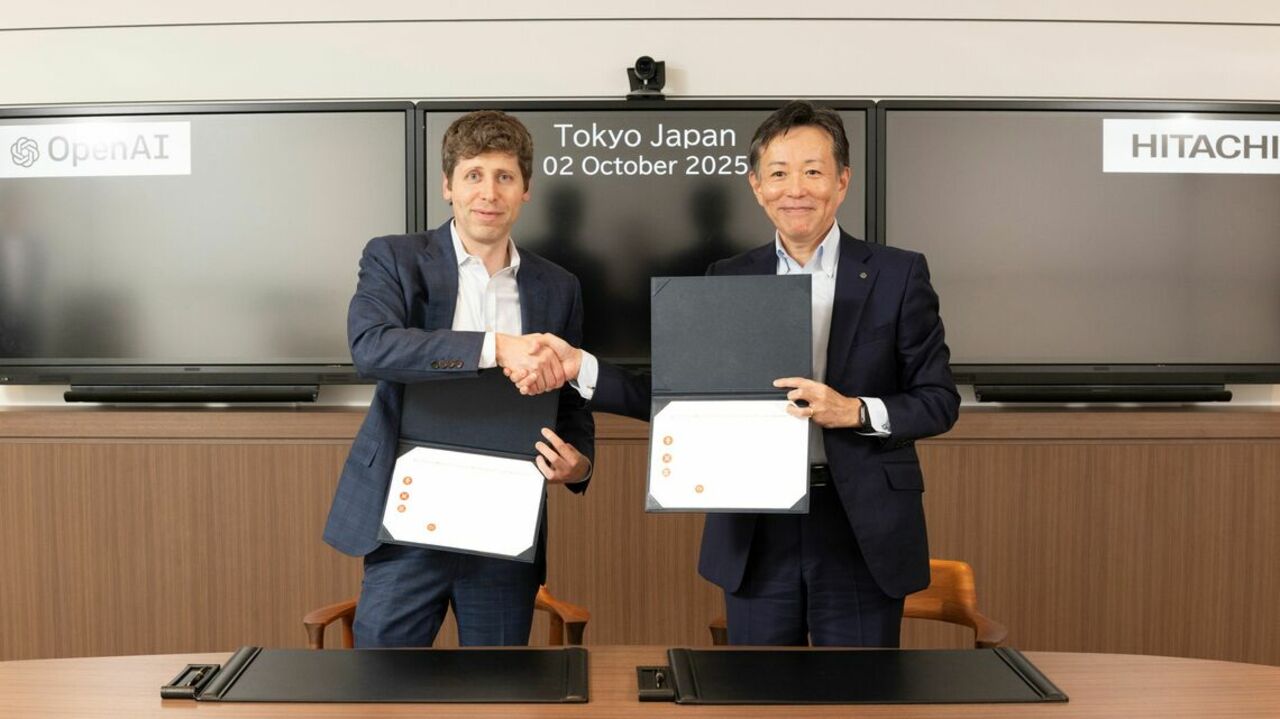
On October 2, 2025, a globally watched entrepreneur made his way to Hitachi’s office in Tokyo.
It was Sam Altman, CEO of OpenAI. Just one week earlier, OpenAI had reached out to Hitachi to express its interest in a potential collaboration.
Inside Hitachi, teams moved at breakneck speed. What areas could the two companies realistically work on together? Materials were prepared rapidly, and on the day of Altman’s visit, Hitachi delivered a 15-minute presentation. That was followed by a rapid-fire exchange, as Altman directed question after question at Hitachi President Toshiaki Tokunaga.
As the meeting drew to a close, Tokunaga cut straight to the point.
“Sam, I think today’s discussion has given us a good sense of what we can do together. Shall we sign a Memorandum of Understanding?”
Altman replied casually, “No problem at all,” and signed on the spot.
Going forward, the two companies will explore cooperation in areas including power transmission and distribution equipment, data center cooling technologies, and the deployment of OpenAI’s large language models (LLMs) within Hitachi.
Jun Taniguchi, CEO of Hitachi’s Strategic SIB Business Unit, who attended the meeting, recalled the moment.
“That must be Silicon Valley culture,” he said. “But from the perspective of traditional Japanese companies, the speed was almost unimaginable.”
From Nvidia to Washington: Hitachi steps onto the global stage
Just weeks earlier, on September 8, Hagerstown, Maryland, was in a festive mood.
The ceremony marking the full-scale launch of Hitachi’s railway factory brought together top management, including Chairman Toshiaki Higashihara and Tokunaga, as well as partners such as Nvidia, state government officials, and representatives from the rail industry. Against a backdrop of Hitachi’s signature red, the ribbon-cutting ceremony felt closer to a high-profile car launch than an industrial milestone.
Just days earlier, on September 5, Hitachi had announced plans to invest more than $1 billion to expand its transformer factory and other facilities in the United States. The move drew a swift reaction from the White House—specifically, President Donald Trump, who responded on X.
Later that month, Tokunaga was among those attending a dinner hosted during President Trump’s October 28 visit to Japan. On the same day, Hitachi signed an MOU with the U.S. Department of Commerce aimed at strengthening power transmission and distribution networks.
OpenAI. Nvidia. The U.S. government.
Hitachi is now building a global presence strong enough to stand shoulder to shoulder with some of the world’s biggest players. Its market capitalization has surpassed ¥20 trillion, and its share price has risen more than fivefold over the past decade. Long known as Japan’s flagship electronics manufacturer, Hitachi is now undergoing a fundamental transformation.
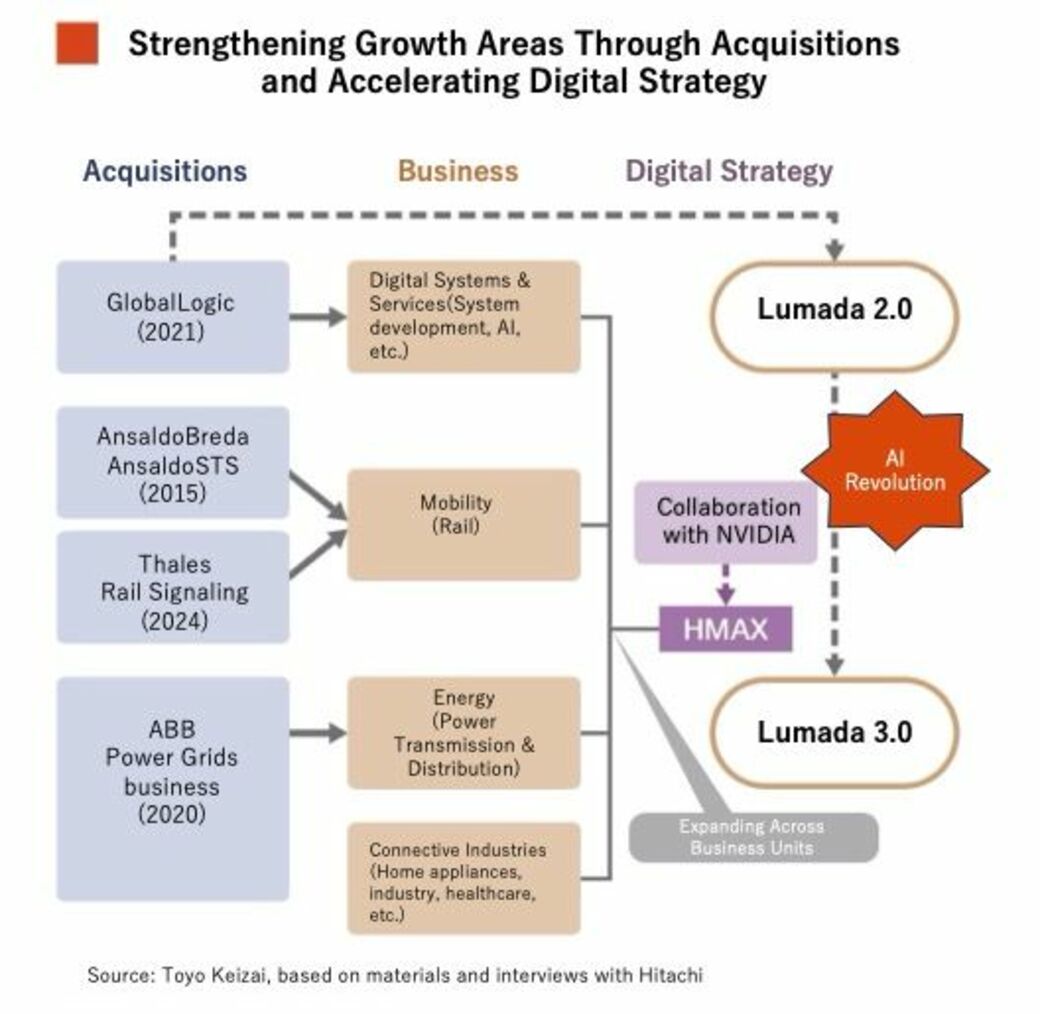
Since acquiring Italian rail companies AnsaldoBreda and Ansaldo STS in 2015, Hitachi has pursued a series of large-scale overseas acquisitions. Following its acquisition of the Power Grids business of Switzerland-based ABB in 2020, the company went on to acquire the rail signaling business of France’s Thales in 2024.
As it strengthens its rail and power grid operations, Hitachi has steadily expanded its global business footprint and customer base.
Once a manufacturing-led company, Hitachi has reshaped itself around services that improve and optimize social infrastructure. About 60% of its revenue now comes from overseas, and roughly the same share of its 280,000 employees are based outside Japan. Its executive leadership reflects that global footprint.
A “decide fast, act fast” culture
In 2021, Hitachi made its largest-ever acquisition, spending about ¥1 trillion to acquire GlobalLogic, a Silicon Valley–based digital engineering firm. The deal was meant to bolster Lumada, its digital transformation platform launched in 2016. It did more than that: it injected an agile culture into the organization.
Tokunaga, who led the GlobalLogic acquisition, emerged as a central figure in that transformation. In April last year, the 58-year-old stepped into the top job at Hitachi and is widely credited by executives with ushering in a more agile management style.
Tokunaga himself puts it simply. “When I talk to employees, the first thing I mention is agility. If you’re doing the same thing, the faster one wins.”
On the sales front, Masahiko Hasegawa, Senior Vice President and Chief Marketing Officer, who leads Hitachi’s global sales team, says the company has been moving aggressively over the past six months to build market-entry strategies for new growth areas such as data centers and mobility. “Since April, the sense of speed has completely changed,” he adds.
A representative from Google Cloud echoed that view, pointing to its joint development of AI agents for field operations with Hitachi.
“Hitachi operates at a different speed. While commercialization usually takes time, this time we were able to make the announcement just two to three weeks after the initial discussion.”
Turning Into a Silicon Valley–Style Company
This reflects the Silicon Valley mindset: when something comes up, developers quickly come together, discuss ideas on the spot, and begin building prototypes. Rather than trying to get everything right from the start, they shape ideas in real time and build together. This “decide and act immediately” culture is gradually taking hold even within Hitachi.
Perhaps the clearest example is Hitachi’s partnership with Nvidia in 2024. The MOU was signed on the very day Tokunaga met with CEO Jensen Huang.
Six months later, Hitachi launched HMAX—an infrastructure maintenance and management solution built on Nvidia’s technology—as part of its Lumada business.
“It’s highly unusual for Hitachi to collaborate and roll out a service at this pace,” says Strategic SIB's Taniguchi, who is also involved in the Lumada business.
Joining Silicon Valley’s ecosystem following the GlobalLogic acquisition has also been significant.
Taniguchi, who leads new business development there, says that whenever an interesting theme emerges, he reaches out to key figures at big tech companies, and before long, it becomes, “Let’s meet at Starbucks.”
At those meetings, discussions quickly turn to ideas such as, “This might be the right kind of partner,” or “This person could handle that.”
Inside Tokunaga’s hands-on AI playbook
Even as Hitachi accelerated its globalization and digital transformation through a series of acquisitions, the world was undergoing a seismic shift: the rapid rise of generative AI.
Last October, Ryo Kurokawa, Vice President AI Strategy AI & Software Services Business Unit, was preparing materials for an AI strategy briefing for journalists. The presentation laid out Hitachi’s ambition to become “the world’s leading player in Physical AI,” positioning HMAX as its core solution.
Physical AI, which embeds artificial intelligence in physical systems such as industrial equipment and infrastructure to enable autonomous operation, is emerging as a fast-growing market. U.S. research firm Grand View Research estimates it could reach around ¥19 trillion by 2030.
The briefing deck ran to about 30 pages. Tokunaga weighed in on almost every page, sending detailed feedback by email nearly every day—often along the lines of, “this should be this way,” or “that should be that way.”
“That deck really bore Tokunaga’s stamp,” Kurokawa says. “It wasn’t something our AI team simply drafted and brought to him for approval.”
The deck captured Tokunaga’s thinking on where AI is heading—and where Hitachi fits in.
"Digital players are now using AI to improve the 'real world' and make it more efficient," says Tokunaga. "In that context, Hitachi’s ability to bring together OT (operational technology) and products—equipment and physical assets—becomes a major strength."
Hitachi has spent years integrating the "real-world side"—factories, railways, power plants, and other OT-controlled social infrastructure—with the IT side, which handles software and systems development.
At first, this integration was marked by constant trial and error. The OT side, focused on building products designed to operate reliably for decades, and the IT side, accustomed to continuous updates and iteration, often struggled to align.
“When OT and IT teams first came together, there must have been tensions that are hard to put into words,” Kurokawa says.
Even within Hitachi’s IT operations, AI research had long been carried out in silos—across different fields and programming languages—limiting collaboration. Generative AI changed that almost overnight.
“Since researchers from different AI disciplines began gathering in one place, competition has intensified,” says Jun Yoshida, Head of Hitachi’s Generative AI Center. “Amid a shared sense that ‘Hitachi needs to change too,’ researchers are pushing hard to deliver results.”
That combination is what attracts companies like Nvidia and OpenAI: Hitachi can engage digital platforms as an equal partner, while also owning critical physical infrastructure—from power generation to transmission and distribution equipment. Beyond that, its footprint spans everything from data centers and energy to cooling technologies.
Will SoftBank become Hitachi’s next rival?
Until now, Hitachi has focused on growth by business segment while pursuing global expansion. Looking ahead, Tokunaga says the company aims to grow with digital technology at its core, while continuing to deliver value unique to Hitachi.
Hitachi’s adjusted EBITA margin for fiscal 2024—adjusted operating profit plus amortization of intangible assets related to acquisitions—stood at 11.1%. While that is a solid figure for a manufacturing company, Hitachi is targeting 13–15% by fiscal 2027.
At the center of that effort is Lumada. In April, Hitachi rolled out an upgraded version—Lumada 3.0—powered by AI, and is now accelerating its AI-driven businesses at full speed. Over the long term, the company aims to increase Lumada’s revenue share to 80%, though significant hurdles remain.
Ryo Harada, an analyst at Goldman Sachs, notes that over the past year, “the shift toward Lumada has not progressed as much as expected.”
“There has been progress at Hitachi Rail,” he adds, “but it has been somewhat slower at Hitachi Energy, partly because customers are reluctant to connect their systems to networks for security reasons.”
As Hitachi moves deeper into Physical AI, new competitors may also emerge. In October 2025, SoftBank Group announced it would acquire ABB’s robotics business for approximately ¥820 billion, signaling its push to strengthen its position in Physical AI.
“When competition plays out on both fronts—hardware and software—speed is what ultimately decides the race,” Harada says.
As Hitachi accelerates its global push, this series will explore both the front lines of its transformation—and the changes taking shape inside the company.
This article is part of "Hitachi's Global Ambitions," a special feature originally published in Toyo Keizai from July to November 2025. English edition prepared for The Oriental Economist.
