

Nine years ago, Lumada was dismissed by some as “all concept, no substance.” Today, it has grown into a ¥4 trillion business at the core of Hitachi’s digital strategy.
Launched in May 2016, Lumada was initially positioned as an IoT (Internet of Things) platform to support Hitachi’s digital transformation. Since then, it has steadily evolved.
The first turning point came in 2021. Hitachi acquired GlobalLogic, a U.S. digital engineering firm, for approximately ¥1 trillion, seeing it as a key piece in further strengthening Lumada. The acquisition added planning and proposal capabilities closer to customers that had previously been lacking, marking a step up to “Lumada 2.0.”
That evolution accelerated with the rise of generative AI. In April 2025, Hitachi unveiled “Lumada 3.0,” followed in September by the launch of the Lumada 3.0 Strategy Promotion Office.
“Lumada 3.0 is about using advances in AI to make social infrastructure smarter—and ultimately more valuable,” says Jun Taniguchi, who heads the office and leads the Strategic SIB Business Unit.
Hitachi’s strength lies not just in the data it gathers from real-world settings such as social infrastructure, but in its ability to make sense of that data. Lumada 3.0 builds on this by combining AI with Hitachi’s deep domain knowledge—experience and insight accumulated over decades—to further enhance the operation of social infrastructure.
What has Lumada achieved so far?
Initially criticized as heavy on concept and light on substance, Lumada has since delivered tangible financial results.
Sales revenue from Lumada nearly doubled, from ¥1.96 trillion in fiscal 2022, and is expected to reach ¥4 trillion by fiscal 2025. Over the same period, Lumada’s share of Hitachi Group revenue is set to rise from 26% to 39%.
Looking ahead, Hitachi’s latest business plan targets Lumada to account for 50% of group revenue by fiscal 2027, with a long-term ambition to lift that share to 80%.
“That target sent a jolt through the organization—it crystallized where Hitachi is headed,” says Shinichiro Fukushima, who leads the Lumada Innovation Hub Tokyo.
Established in 2021, the hub hosts seminars and workshops for customers and partners and serves as a hub for new Lumada-driven businesses to be conceived and developed.
“Lumada can still be hard to understand,” Fukushima says. “That’s exactly why this hub exists—to explain it and put it into practice.”
By September 2025, more than 68,000 people had visited the hub.
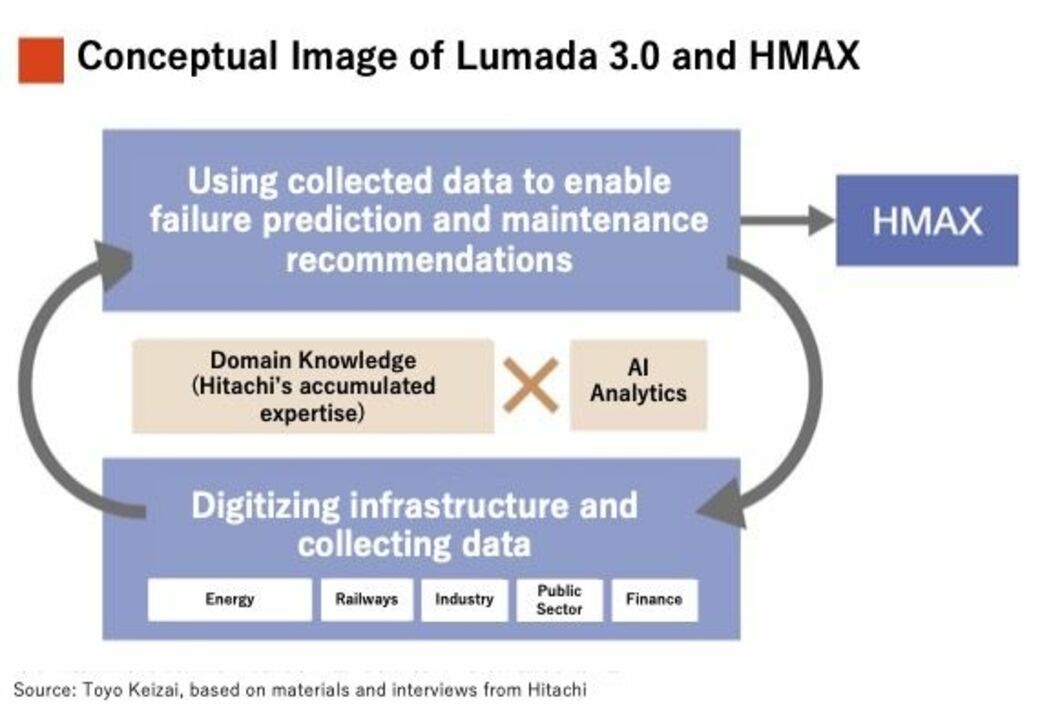
At the heart of Lumada is a cycle in which data flows from infrastructure to AI—and back again.
According to Taniguchi, Lumada is built around a continuous cycle rather than a one-way system. The upper layer consists of AI-driven digital services, while the lower layer collects data from social infrastructure such as railways, energy, and industrial systems.
At the upper layer, data collected from various infrastructure types is analyzed using AI to generate insights into efficiency and safety. Those insights are then fed back into the underlying infrastructure layer, accelerating digitalization and driving further evolution across the system. Hitachi sees this continuous feedback loop as one of Lumada’s core strengths.
Scaling Across Hitachi’s Businesses
Looking ahead, HMAX—an infrastructure maintenance and management solution launched in November 2024 ahead of Lumada 3.0—will play a central role in driving revenue growth.
Originally introduced for railway operators, HMAX is now planned for broader rollout across the energy sector, industrial applications, and financial services. As part of that effort, Hitachi unveiled “HMAX for Building: BuilMirai” last October, a version tailored for building maintenance.
“Until now, Lumada has focused on using digital technology to strengthen individual businesses,” Hitachi's President Toshiaki Tokunaga says. “With HMAX, we finally have a way to scale that value across Hitachi as a whole.”
After two major turning points and the shift to Lumada 3.0, Lumada now sits at the core of Hitachi’s growth strategy.
This article is part of "Hitachi's Global Ambitions," a special feature originally published in Toyo Keizai from July to November 2025. English edition prepared for The Oriental Economist.
