
There was a familiar scene in Hitachi’s overseas sales efforts a decade ago: After negotiations finally reached the table, executives shook hands with a customer’s CEO, only to find that there was no local delivery structure in place and a lack of coordination with the business divisions.
Since 2013, Hitachi has launched multiple overseas sales initiatives. While each delivered some results, they also exposed persistent weaknesses—limited resources and a lack of coordination between headquarters-led strategies and individual business divisions.
Against this backdrop, the company launched a new sales initiative in earnest in fiscal 2023.
Inside the company, the reaction was far from enthusiastic. “Are we really doing this again?” people wondered. “And will it actually work this time?”
Even so, the effort is now beginning to deliver tangible results.
A big reason this time is Hitachi’s wave of major acquisitions overseas. Over the past decade, it has acquired Italy’s AnsaldoBreda and STS, ABB’s power-grid business, and the U.S.-based digital engineering firm GlobalLogic.
Those deals didn’t just add new businesses. They brought local sales teams, on-the-ground sales capabilities, and—crucially—established customer relationships in each market.
Because many of its key customers operate globally, Hitachi has begun organizing sales teams that cut across businesses within the group. The aim is to leverage a diversified conglomerate's capabilities—combining multiple businesses within a single customer relationship.
As a result, the number of “strategic customers” has increased from 13 in fiscal 2022 to 36 today, with five of them now tied to formal strategic partnerships.
Of these, teams for 19 customers were established in fiscal 2025. Since April, when Toshiaki Tokunaga assumed the role of president, the pace of expanding strategic customer coverage has clearly accelerated.
From Auto Parts to Storage—and Beyond
The impact is already visible on the ground. For example, when a German automaker faced new challenges as digitalization accelerated and the shift to electric vehicles gained momentum, Hitachi's sales lead, with an established relationship with the customer, worked closely with the group’s digital teams to better understand its evolving needs.
Rather than limiting the discussion to conventional automotive components, the team proposed a broader approach that drew on multiple businesses across the Hitachi Group.
As a result, Hitachi secured orders across the group, including data storage solutions from Hitachi Vantara and advanced driver-assistance systems developed by GlobalLogic. The engagement later expanded into a strategic partnership covering EV battery health diagnostics and battery manufacturing.
“For customers who had never thought of Hitachi as a digital partner, this was a moment when they clearly recognized that we do, in fact, have strong digital capabilities, including software,” says Masahiko Hasegawa, Representative Executive Officer and Senior Vice President, who serves as Chief Marketing Officer. He heads the Global Marketing & Sales Transformation (GM&S) program, the sales reform initiative launched in 2023.
In the past, sales were handled separately by individual business units, making it hard for customers to grasp Hitachi’s full value.
Today’s sales teams are deliberately structured differently—bringing together people from across the group, including overseas talent added through acquisitions such as Hitachi Energy and GlobalLogic.
The team led by Hasegawa is spread across the globe.
The head of marketing is based in Dubai, while teams responsible for functions such as sales technology and talent management operate from locations including Italy, the UAE, and the U.K.
Challenges Exposed by Earlier Efforts
Each strategic account is led by a Group Account Manager, or GAM.
A GAM is typically an existing sales executive who has built the strongest relationship with the customer. Around that individual, Hitachi assembles a virtual, cross-functional team, drawing members from relevant business units, regional offices, legal, and R&D. Responsibility is shared across the entire team—not placed on the GAM alone.
This approach is rooted in the framework used by ABB’s power grid business, which Hitachi acquired. Talent from ABB was brought in, and the model was adapted into Hitachi’s own program. The global marketing leader currently driving the initiative under Hasegawa also previously worked at ABB.
Work on the new program began in fiscal 2022. The idea was simple: make better use of global talent; move away from selling products toward understanding what customers actually need; bring different business units together to offer the right combinations; align goals and KPIs upfront; and give teams the market insights and tools they need to execute.
The results have been tangible. Orders from 17 strategic customers rose 18% year on year in fiscal 2023, followed by a 38% increase in fiscal 2024.
“For our own KPIs, we start with the combined budgets of the relevant business units for each strategic account and then build in an additional value component,” Hasegawa says. “In both fiscal 2023 and 2024, we exceeded our targets.”
Incentives have also been established to make it easier for GAMs to join the teams. Half of a GAM’s base salary and bonus is paid by the business unit to which the GAM belongs, with the other half covered by headquarters. This arrangement effectively halves the bonus burden for the business unit.
Turning Small Wins into Momentum
Hitachi has also overhauled its marketing approach, moving toward more tailored strategies for individual customers while rolling out a platform that centrally aggregates and analyzes technology and marketing information across the group.
The aim is to consolidate information previously scattered across business units to enable market analysis from a company-wide perspective. The team has also developed a tool that visually maps Hitachi’s vast and increasingly complex portfolio—expanded through M&A—against the specific challenges faced by individual customers or industries.
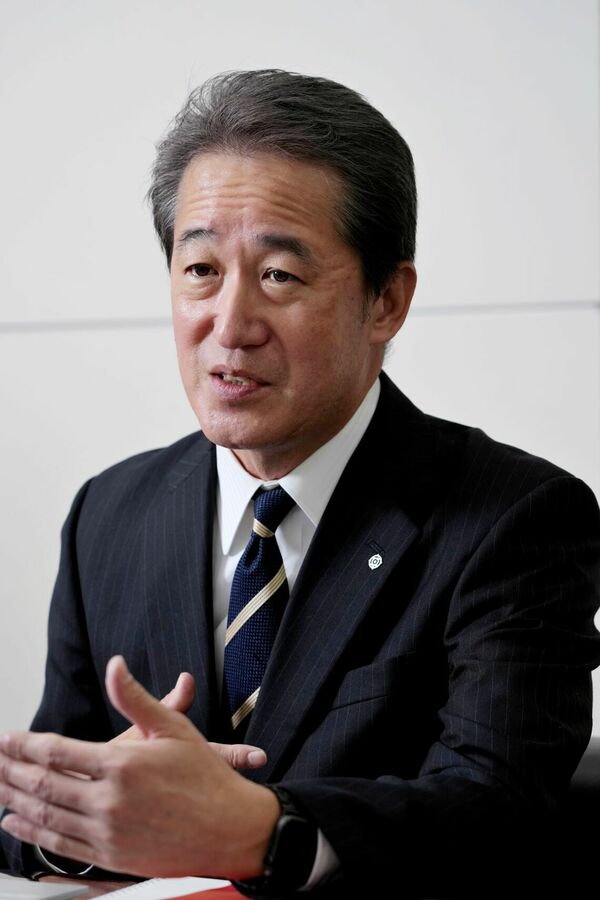
“For example, some salespeople in the data center market don’t fully understand the range of solutions Hitachi offers,” Hasegawa says. “They may be selling transformers, but lack visibility into what else is available. The mapping tool makes the full picture clear at a glance—and shows who to contact.”
The focus is on building momentum through small, repeatable wins. “We show people internally: ‘This is what we did, and this is what came out of it,’” Hasegawa explains. “By demonstrating that it works, we can scale it step by step.”
Internal awareness is also growing. Questions like, “Shouldn’t GM&S be handling this?” are coming up more often, and requests for support—from running workshops to using marketing tools—are on the rise.
The mindset of people working on strategic accounts is also beginning to shift. In workshops on how teams should be structured, people often get excited as they realize just how many different things the Hitachi as a group can actually do, Hasegawa says.
That said, Hitachi does not plan to expand its current roster of 36 strategic accounts indefinitely. Alongside this, it is developing a region-led approach—known as “regional accounts”—that uses the same marketing tools. The next step is to establish a repeatable formula for success, and then scale it across the group.
This article is part of "Hitachi's Global Ambitions," a special feature originally published in Toyo Keizai from July to November 2025. English edition prepared for The Oriental Economist.
