
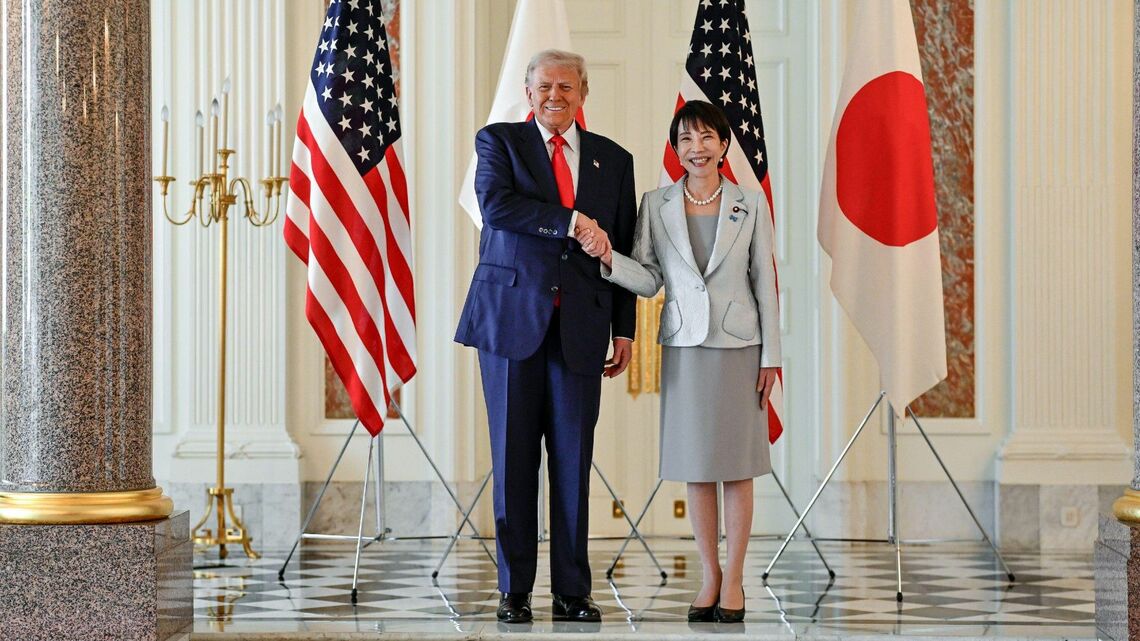
Prime Minister Takaichi Sanae wants the coming election to be a referendum on her personal leadership. In that contest, she has already won one vote – from U.S. President Donald Trump.
Is a clear victory for Takaichi the best outcome for the U.S? “Absolutely,” Kenneth Weinstein, an advisor to Trump, declared without hesitation.
Weinstein is the Japan Chair at the conservative Hudson Institute thinktank and was the nominee to be Ambassador to Japan during the first Trump administration. In an interview with Toyo Keizai Online, he explained why a Takaichi triumph fits the Trump administration agenda.
“She is clearly focused on defense, national security, upgrading Japan’s security posture, upgrading Japan’s security capabilities, someone willing to work closely with the United States, and our allies, and willing to deepen the ties in the Indo Pacific that we in the United States have been less effective in doing,” Weinstein explained.
Clearly, Takaichi is seen as a loyal follower of Trump, one unlikely to challenge the U.S. as Europe and Canada are now doing in response to the military operations in Venezuela and the threat to seize Greenland.
“I don’t think the Takaichi administration is going to say a word about Greenland,” the distinguished American Japan scholar Gerald Curtis told Toyo Keizai. “Of all the allies, Japan is the one with which Trump has the least problems.”
American preference for Japan to be governed by the conservative Liberal Democratic Party (LDP) is hardly unusual. But Takaichi is viewed as a significant improvement over the previous government of Prime Minister Ishiba Shigeru who sought to create some distance from the U.S.
Instead, the Trump administration expects a victorious Takaichi government to rapidly increase defense spending and take on the responsibility for regional security in the Asia Pacific.
“We also need someone who understands the immense burdens that the Japanese people are going to have to bear in terms of their own national security,” Weinstein said. “And she is as good as it gets.”
The China question between Trump and Takaichi
For China hawks, like Weinstein, a strong Takaichi government is useful in bolstering those who are worried about an American retreat from Asia and a grand bargain with China’s Xi Jinping when the President goes to China in April.
“We need a strong leader and strong partner to keep us focused, on China, on the Taiwan challenge, on the Scarborough Shoal challenge,” the Hudson Japan chair who formally was the CEO of the thinktank, told us.
Weinstein and other Japan hands are carefully critical of Trump’s failure to come to the open support of Takaichi after her comments on Taiwan and the massive pressure campaign mounted by China against her government.
But he and others dismiss fears that Trump is heading toward some kind of G-2 grand pact with China. They point to the attack on Venezuela and the pressure on Iran as moves that effectively strike at China which is dependent on those countries for oil.
They see the approval of arms sales to Taiwan and the recent trade agreement with Taiwan as further evidence that Trump is not planning on abandoning Taiwan in the pursuit of a deal with Xi.
Trump is seeking a bargain with Xi but not a grand alliance, Weinstein contends. His hesitation in backing Takaichi against China was tactical. “The president doesn’t want to have an open confrontation with China on the eve of his summit,” he said.
“Trump wants to strike a big deal with China,” Patrick Cronin, Asia-Pacific security chair at Hudson, told this writer. “But this is not some game-changing G2 moment.” He compared it to the talks between Xi and former President Joe Biden in seeking strategic stability, one that avoids the difficult issue of Taiwan.
Takaichi’s “big mistake” was to undermine Trump’s desire to make this deal with Xi, observed Curtis, an emeritus professor at Columbia University. “I wasn’t surprised that he was upset with Takaichi and called her and told her to get out of this mess.”
If Takaichi manages a decisive victory in the February election – and there is no consensus on this among American Japan hands – she will then head to Washington for a meeting ahead of Trump’s April trip to Beijing.
But that meeting may be even more challenging for a stronger Takaichi than if she still leads a weak coalition government.
Curtis predicts that Takaichi will not focus on China in Washington. “She knows that is not a winning issue for her in dealing with Trump,” he told Toyo Keizai. “Trump is interested in money and he wants to have his 550 billion bucks. It is his money and she better get it to him.”
Trump of course is unpredictable but within the Trump administration bureaucracy, to the extent it plays a role in forming policy, the focus is on strengthening security ties. That is particularly true for those who want to push a harder line toward China and want Japan to vastly increase its defense spending.
“Both State and Defense are very interested in making effective cooperative deals with Japan and they think Prime Minister Takaichi is clearly the best person for that now,” said Cronin, a prominent security expert.
“From the Pentagon’s perspective, you are either helping deterrence against a China contingency or you are not,” he explained. “You have to look tough if you want to keep the peace. She has bought into that security paradigm.”
How the Americans see the election prospects
Among the Trump advisors, there is praise for Takaichi’s decision to call a snap election and, at this early stage, an expectation of a clear, even dramatic victory.
“It seems like an incredibly smart move politically,” Weinstein told TOE. “If the polling numbers stay where they are for her, she should have a resounding victory that will really change the shape of the Diet moving forward. It looks like a strong return of the LDP after the weaknesses shown in the Upper House elections not too many months ago.”
Even some non-Trump analysts share this assessment of the decision to go down this somewhat uncertain road.
“No election is free of risk but for Takaichi the risk of losing seats in an election held now would not be as nearly as great as the risk she would be facing by waiting too long,” argued Curtis, probably the most well respected observer of Japanese politics in the U.S. “Better to strike now with her public support at more than 70 percent, the political opposition in disarray, and public opinion polls and the LDP’s own election district by district analysis indicating the strong possibility that the LDP would win the 235 seats needed for a majority and perhaps garner as many as 260 seats.”
Both men attribute the prospects for victory to Takaichi’s personal appeal, not to the popularity of the LDP or her policy proposals for taxes or other domestic issues, even including her embrace of Trump-like anti-immigrant rhetoric.
Takaichi “is running a presidential style race,” said Weinstein. “I don’t see her running as the LDP,” he added. Others have compared her not to Abe Shinzo, her mentor, but to Koizumi Junichiro who won election a quarter century ago by running in some ways against the LDP as well as the opposition.
Takaichi’s popularity, in their view, seems to be due primarily to the uniqueness of her being the country’s first female prime minister, her image as a decisive and confident leader, and her ability to benefit from a rightwing shift among the Japanese public and among younger people in particular. Her ability to manage ties with Trump, and with South Korea’s Lee Jae Myung, as well as stand up to China has worked to bolster this image of a strong leader.
This assessment is not universally shared among American Japan experts who are also intrigued by the formation of a new centrist alliance of the Constitutional Democratic Party and the Komei party, whose loyal voters provided a key margin of victory for decades in their now broken alliance with the LDP.
Cronin, who is also based on the pro-Trump Hudson Institute, is more skeptical about a clear Takaichi victory next month.
“I think the assumption a couple of weeks ago was that she could ride her huge popularity and enlarge her majority in the Diet,” he told TOE. “But the politics now look challenging for her. She is facing a united opposition, she lacks a unified coalition, and she is facing a twin set of pressures from China and from the US, in terms of economics. She can still win a majority, but I wouldn’t bet on it.”
Whether Trump is even thinking much about this situation, given the focus on Greenland and his domestic battles, is doubtful. Nor is there much thought about the possibility that a rightwing nationalist government in Japan may head off in a very independent direction. But for now, the fact that Takaichi is Trump’s choice for Japan is undeniable.
